Does an RV inverter need to be earthed?
6 min read
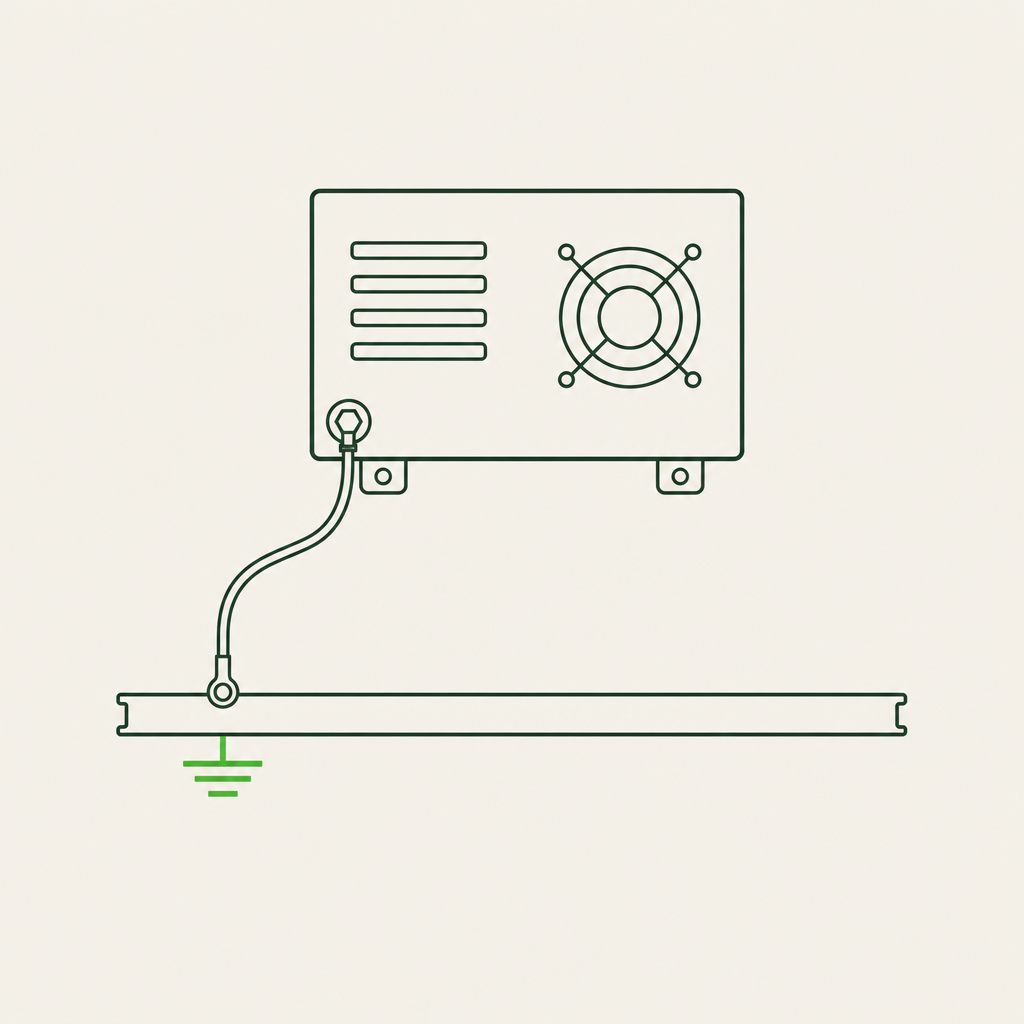
Two separate jobs, and both matter. The inverter's exposed metal case has to be bonded to the vehicle chassis, so a fault inside the unit cannot leave metalwork live. Separately, the AC neutral and the safety earth have to be joined in exactly one place in the system, so that a fault has a path that lets the protective device operate; if your inverter has no transfer switch, that bond is usually not inside the inverter and has to be made elsewhere. Whether a particular unit bonds neutral to earth internally is not something to assume — it belongs in that unit's manual.
The case and the neutral are different questions
The case is about the metal you can touch. An inverter's enclosure, its earth stud and any exposed metalwork should be connected to the vehicle chassis with a proper cable and lug, so that the chassis becomes the reference any protective device works against. The neutral bond is about the AC circuit's own reference: without it, an earth leakage device has nothing to compare against and may not operate at all.
Why the neutral-earth bond has to exist
In an earthed installation the safety earth and the neutral are joined at one point, and that join is what turns a short to earth into a large fault current instead of a quiet leakage. A vehicle running from its own inverter has no utility supply providing that point, so unless something else does, the AC system floats. The consequences are practical rather than theoretical: a residual current device may refuse to trip, and metalwork that should be safe can sit at an undefined potential.
Why there should be only one bond
Two bonds in the same system give the neutral return current a parallel path through the earth conductor. That shows up as nuisance tripping, as current in a conductor that was never sized for it, and occasionally as a shock risk where you least expect one. The rule is one bond in the system at any moment, which is what an inverter with a built-in transfer switch normally manages: units of that kind commonly bond the neutral while they are inverting and release the bond when they pass shore power through to the loads.
What changes when shore power is connected
Plugged into a campsite supply, the vehicle's earth arrives with that supply and the bond is normally made at the supply rather than in the vehicle. The installation therefore has two states, and the bonding has to be right in both of them. This is the practical reason a whole-vehicle pass-through arrangement needs more thought than a single dedicated inverter socket.
Do not copy an installation from a forum
The requirements for protective earthing, for the use of residual current devices and for how a vehicle's AC installation is treated differ between countries, and they have changed over the years. A layout that is correct somewhere else may not satisfy the rules where the vehicle is used, and an insurer may take the same view. Have the AC side of the installation inspected by someone qualified to judge it in your jurisdiction.
What the range publishes
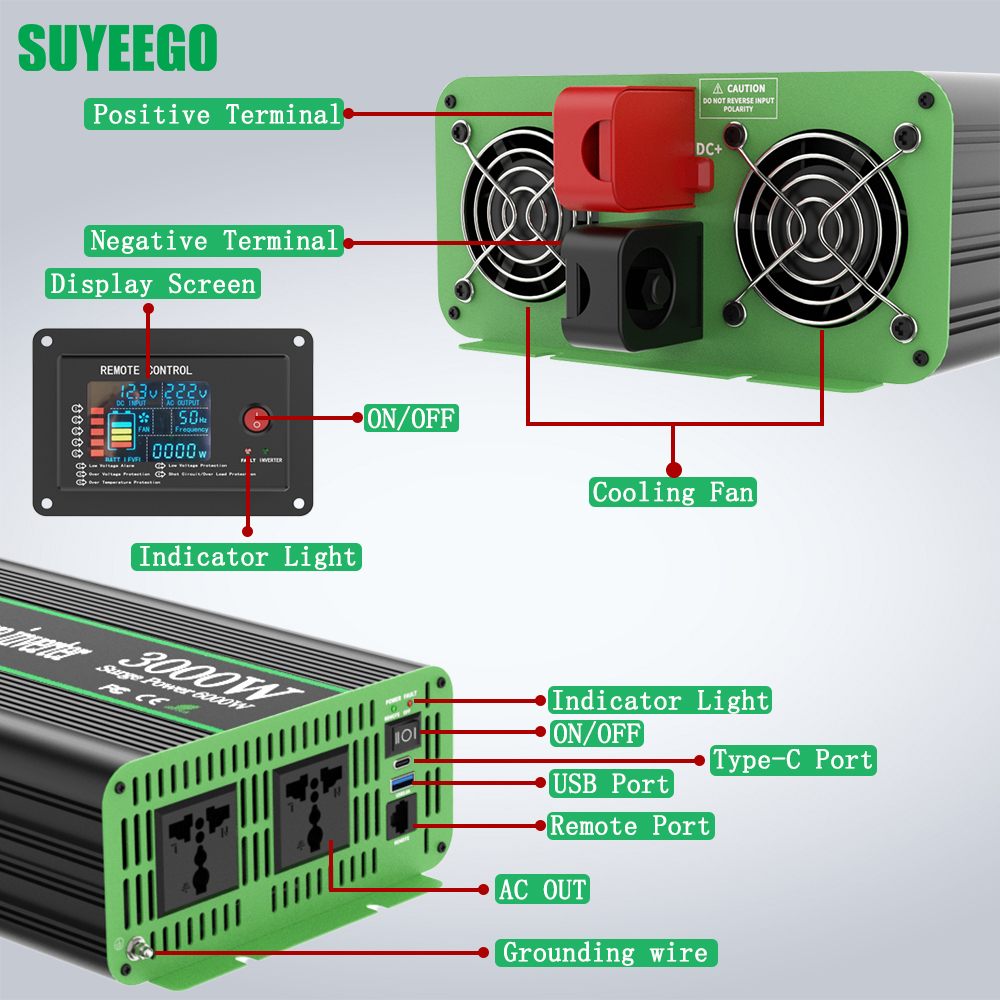
The SYGG-FSC range publishes protection against overload, short circuit, overheat and reverse connection, a low-voltage alarm at 10.5V with cut-off at 10V on a 12V bank and 21V with 20V on a 24V bank, 12V or 24V DC input, 110V or 220V AC output at 50Hz or 60Hz, and CE, FCC and RoHS certification. It is a straight inverter with no built-in transfer switch, and its published specification does not state whether the neutral is bonded to earth internally, so confirm that with us for the model and the market you are ordering.
Frequently asked questions
- Do I need an earth rod for an RV inverter?
- Not as part of the vehicle's own installation. On a vehicle the chassis is the earth reference, and a rod driven at a pitch is part of that site's supply arrangement rather than part of the vehicle. The rules for the site and for the vehicle both apply, and they are not the same document.
- Can I bond the neutral to the battery negative instead?
- In most 12V vehicles the battery negative and the chassis are already the same node, which is why the bond is easy to make and equally easy to make twice. Make it deliberately, in one place, and only in a way the wiring rules that apply to you permit.
- Why does my residual current device trip when I run on the inverter?
- Usually because the neutral-earth bond is either missing or duplicated. A missing bond leaves the device unable to detect a fault; a duplicated bond gives neutral current a parallel path that the device reads as leakage.
- How do I know whether my inverter bonds neutral to earth internally?
- From its manual or from the supplier. It is not something to infer from the terminals or from how the unit behaves on a bench. Our published specification does not state it, so ask us for the model you are considering.