Is a DC DC charger better than a split charge relay?
7 min read

They do different jobs. A split charge relay simply connects the two batteries in parallel once the engine is running, so the auxiliary battery receives whatever voltage survives the trip down the cable. A DC DC charger converts that input to a chosen charging voltage and holds a charging profile, which is what lets it bring a battery to full charge and what makes it the usual choice for lithium and for long cable runs.
What a split charge relay actually does
A relay, or a voltage-sensitive version of one, is a switch. When the engine starts and the vehicle's charging system comes up, it closes and puts the starter battery and the auxiliary battery in parallel. From that moment the two are one bank, and the alternator's regulator sees the pair of them together.
There is nothing wrong with that arrangement in principle. It is simple, it has no conversion losses of its own, and for a conventional lead-acid auxiliary battery in a vehicle with a fixed-voltage alternator it has worked for decades.
Where the arrangement runs out of road
The problem is that a relay has no way to set a voltage. The auxiliary battery receives whatever the vehicle's charging system holds at the far end of the cable run, and that is not the same as the voltage set at the alternator. Current through the run's resistance produces a difference, and the difference grows with current, as it does in any circuit.
- A charging profile needs more than one voltage. Holding an absorption voltage for a period is what finishes a charge, and a relay cannot hold a voltage at all.
- A lithium battery wants a higher and more tightly specified charging voltage than a lead-acid one, and a relay cannot raise the vehicle's voltage to provide it.
- The longer the run from the front of the vehicle to the auxiliary battery, the larger the gap between what the alternator sets and what the battery receives.
- Anything that relies on the battery reaching a full state of charge — a shunt-based monitor, for instance — will read the shortfall as a load or as lost capacity.
What the charger changes
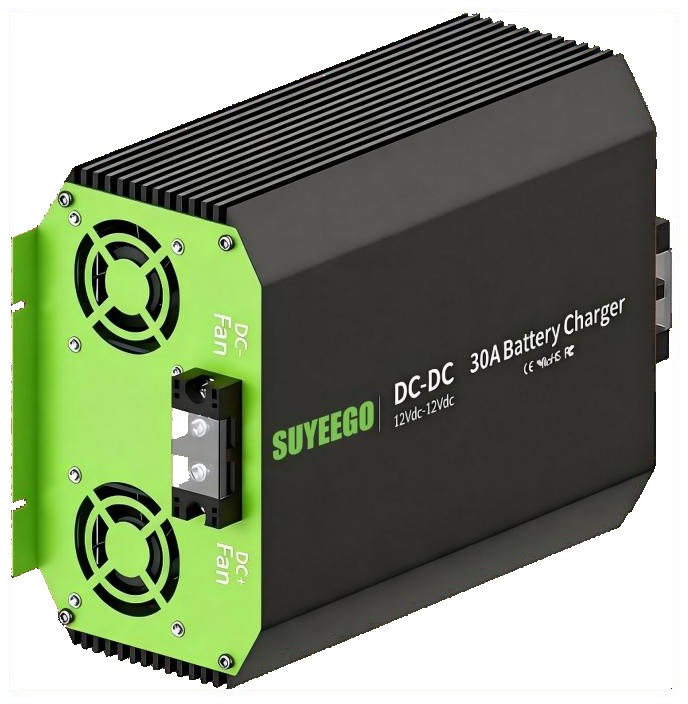
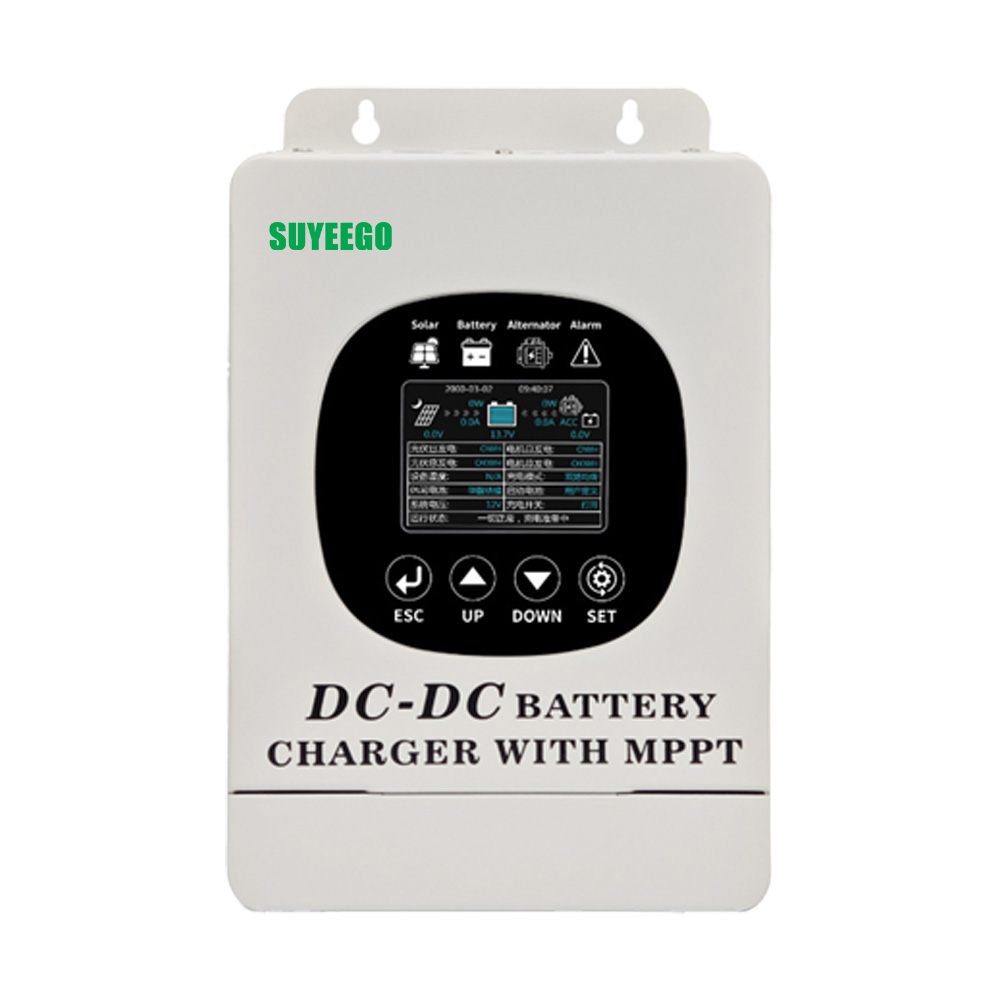
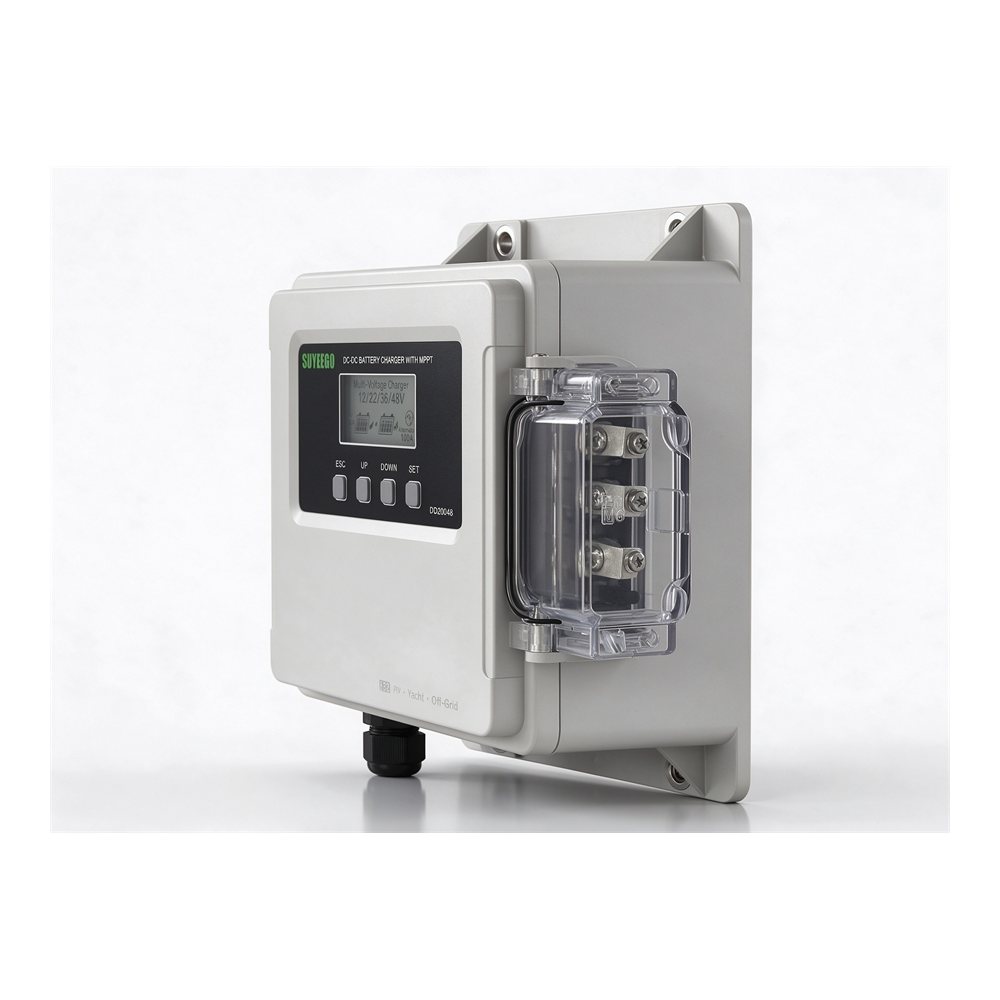
A DC DC charger sits between the two batteries and converts. Instead of passing through whatever voltage arrives, it takes the input, converts it up or down as needed, and delivers a charging voltage of its own choosing to the auxiliary battery.
- The 12V range publishes three-stage smart charging, so the profile has a bulk phase, an absorption phase and a float phase rather than a single voltage.
- The same range publishes that it compensates for voltage drop along the cable run, which is the specific weakness a relay cannot address.
- It publishes battery type selection covering flooded, gel, AGM and lithium, so the charging voltage is chosen to suit the battery rather than inherited from the vehicle.
- It publishes charging the auxiliary battery to 100% state of charge as a design aim, which is the outcome a relay cannot guarantee.
Smart and variable-voltage alternators
Modern vehicles often hold the alternator's output deliberately low when the starter battery is already charged, because doing so saves fuel and reduces emissions. That is the arrangement the smart alternator guide is about, and it is the case where a relay has the least to work with: there may be very little voltage above the auxiliary battery's own resting voltage for the relay to pass.
The DD range publishes a generator input window for exactly this situation, covering both a traditional generator voltage range and an intelligent generator voltage range, so the charger can keep converting from an input that a relay would find useless.
When a relay still makes sense
There are honest cases for the simpler answer. A conventional lead-acid auxiliary battery, a short run, a fixed-voltage alternator and a light daily demand is a combination a relay serves perfectly well. The decision turns on how much you need the auxiliary battery to reach full charge, and on how much the cable run will take off the top before the battery sees it.
Frequently asked questions
- Can I keep my split charge relay and add a DC DC charger?
- They are alternative arrangements rather than layers, because both are trying to control the same connection between the two batteries. A charger replaces the relay's job rather than supplementing it, which is why the usual change is to remove the relay rather than to add alongside it.
- Will a relay charge a lithium leisure battery?
- It will connect it, but it cannot raise the voltage to the level a lithium battery wants or hold an absorption voltage for a period. The result is usually a partially charged bank. A charger with a lithium setting is the arrangement that addresses it.
- Is a DC DC charger less efficient than a relay?
- A conversion stage always loses something, and the 12V range publishes an efficiency up to 90% while the DD range publishes a maximum charging conversion efficiency of 98%. Against that, a relay's zero conversion loss is not a gain if the auxiliary battery never reaches full charge.
- Does a relay work with a smart alternator?
- It can still close, but it has nothing to pass through when the vehicle is deliberately holding its charging voltage low. That is the situation a charger's own conversion exists to handle.