How much power does an RV use in a day?
8 min read
There is no useful average, because a van's daily consumption depends almost entirely on whether it runs a compressor fridge, an inverter, or air conditioning. What is reliable is the arithmetic: list every load, multiply its power in watts by the hours it runs, and add the results in watt-hours. Measure it rather than estimate it — a shunt on the battery negative for two weeks replaces a guess with the number the whole system design rests on.
Why a published average will not help you
Two vans of the same size can differ by a factor of four in daily consumption, and the difference is rarely the vehicle. It is a compressor fridge running through the night, an inverter left on standby, or a diesel heater in winter. Any figure quoted as a general average has already averaged those choices away, which is exactly the information you needed.
The number is also the input to every other decision: array watts, battery capacity, controller current, cable gauge, inverter size. Getting it wrong at the start is what produces a system that works in summer and fails in February.
The arithmetic: watts multiplied by hours
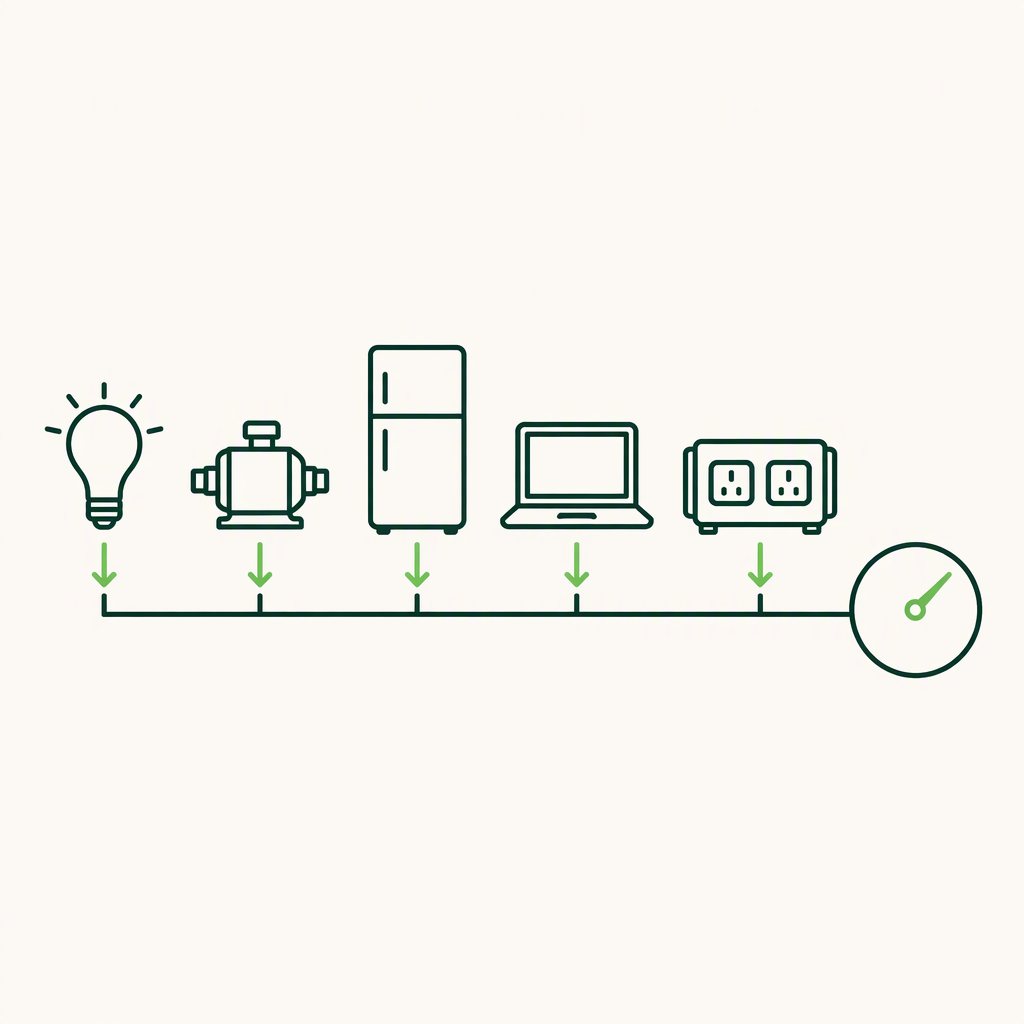
Every load has a power rating in watts and a running time in hours per day. Multiply the two, add the column, and you have watt-hours per day. That is the whole method; nothing else about it is complicated, and no calculator can do it for you because only you know how long the fridge cycles.
| Load | Starting figure | Hours per day | Watt-hours |
|---|---|---|---|
| LED lighting, 4 points | 3 W each | 4 | 48 |
| Water pump | 60 W | 0.2 | 12 |
| Compressor fridge | 45 W running, cycling about half the time | 12 | 540 |
| Laptop charger | 65 W | 3 | 195 |
| Inverter idle draw | 10 W | 24 | 240 |
Three profiles, so you can place yourself
- Lights, pump, phone charging and a 12 V fridge: the smallest realistic system, and the one most weekender vans actually need
- The same plus laptop, router or Starlink and an inverter left running: this is where inverter idle draw starts to rival the fridge
- The same plus any heating or cooling appliance: consumption stops being a battery question and becomes a generator or hookup question
The third profile is worth naming plainly because it is where most disappointment comes from. An air conditioner or an induction hob does not fail for lack of panels; it fails because the energy it wants in an hour is more than a roof array collects in a day.
Measure it for two weeks instead
A shunt on the battery negative counts every amp that leaves and returns, which means it captures the loads you forgot and the standby draw you did not know about. Two weeks covers a weekend and a working week, and it is long enough to catch the habit that only happens sometimes.
Record the daily total, and separately record the worst day. Size the array on the worst day and the battery on the stretch of grey weather you want to survive, not on the average — the average is the number that makes a system look adequate right up until it is not.
Where the number goes next
Once you have watt-hours per day, the rest is arithmetic rather than opinion. Divide by the usable depth of discharge to get battery watt-hours, convert to amp-hours at your system voltage, divide the daily figure by the sun hours of your least sunny month to get array watts, then size the controller to the array's short-circuit current with headroom for a cold bright morning.
Do it in that order and each decision constrains the next. Do it in the reverse order — pick a panel first, then wonder why the battery is flat by morning — and you will be rebuilding the system within a season.
Frequently asked questions
- How many watt-hours does a camper van use in a day?
- There is no single figure. A van with lights, a pump and a compressor fridge sits far below one running an inverter, a router and a heater, and the gap is a factor of several rather than a few percent. Measure your own for two weeks; that number is the only one worth designing around.
- Do I need a shunt to measure consumption?
- It is the cheapest way to get a real number, and it keeps paying afterwards because it tells you what is left in the bank. A clamp meter gives you a snapshot of one circuit at a time, which is useful for tracking down a specific load but tedious for a two-week total.
- Should I size the system on the average day or the worst day?
- The worst day for the array, and the longest grey spell for the battery. Sizing on the average produces a system that is comfortable most of the time and fails exactly when you are depending on it.
- Does the inverter's own consumption count?
- Yes, and it is the load most often left out. An inverter switched on with nothing plugged in still draws power, all day, and over 24 hours that can exceed a small fridge.