Why is my DC charger not charging?
7 min read
Work through the conditions the charger publishes before assuming it has failed: no control signal from the engine, a blown or loose fuse on the input, an input voltage below the cut-off, a panel voltage that has not risen far enough above the battery, a hot unit derating its output, or a battery that is simply full. On the 12V 20A to 60A range the published figures are a low-voltage cut-off at 8V with restart at 10V, and a high-voltage shutdown at 16V with restart at 15.5V.
Start with the signal, not the charger
A DC charger is not supposed to charge whenever the cable is live. It waits for the engine. The DD range publishes an external remote switch control for charging, so if that wire is missing, disconnected or not switching, the charger will sit there looking dead while the alternator is running perfectly well.
The published thresholds that stop charging
| Condition | Published figure | What you see |
|---|---|---|
| Input too low | Low-voltage cut-off 8V, restart 10V (12V range) | Charging stops, then resumes once the input recovers |
| Input too high | High-voltage shutdown 16V, restart 15.5V (12V range) | Charging stops after a jump start or a faulty regulator |
| Panel below the battery | Panel must exceed battery voltage by 2V (DD range) | No solar charging in low light, correctly |
| Unit too hot | High-temperature derating published on the DD range | Output tapers on a hot day or in a closed locker |
| Battery full | Three-stage profile | Current falls to almost nothing at the end of a charge |
| Dark | Night anti-reverse charging protection (DD range) | The solar input stops every evening, by design |
Checks in order
- Control wire first: is it present, and does it change state with the ignition?
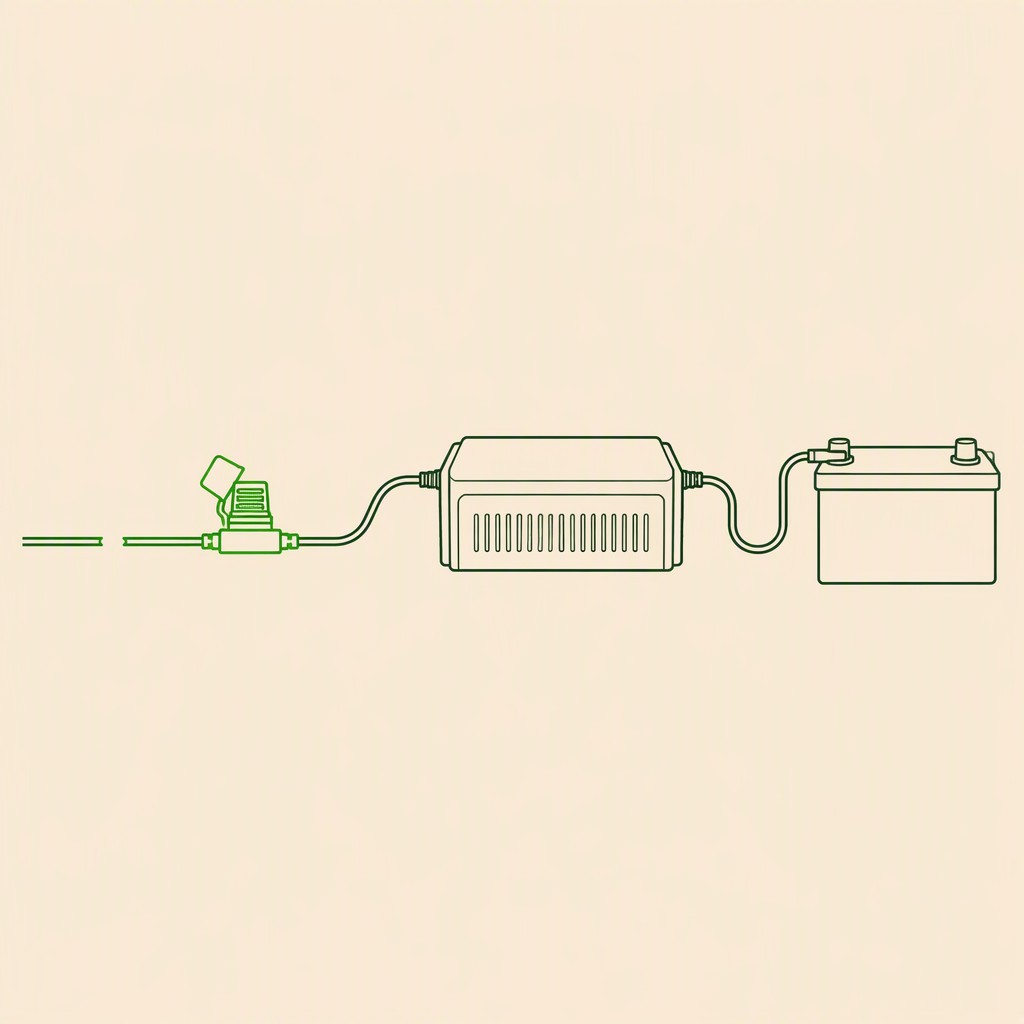
- Fuses and terminations second: a fuse that has blown, or a crimp that has come loose, reproduces an intermittent charger.
- Input voltage third, measured at the charger's own terminals while everything is connected. Compare it with the published cut-off and restart figures rather than with what the dashboard says.
- Panel voltage fourth, if the unit has a solar input: it has to exceed the leisure battery by 2V before the solar side will start.
- Temperature fifth: derating is a published behaviour, so a charger in a closed locker on a hot day tapering its output is working as designed.
- Battery state last: a battery at absorption or float accepts little current, which is the profile finishing rather than the charger failing.
The protection you should not rely on
Reverse-connection protection is published on both range's generator, panel and battery inputs, and it will usually save the unit from a mistake. It is not a commissioning method, so check polarity with a meter before connecting rather than after. If the charger is genuinely dead with the control signal present, the input voltage inside the published window and the unit cold, then the remaining possibilities are inside the box and the honest next step is to contact us.
Frequently asked questions
- Why does my DC charger only charge sometimes?
- Intermittent behaviour usually follows an intermittent cause: a control wire that is not making contact, a fuse holder with a loose cap, or an input voltage hovering around the published cut-off and restart figures. Measure at the charger's terminals while it is failing, not afterwards.
- It worked yesterday and not today, with nothing changed. What now?
- Temperature and battery state are the two conditions that change without anything being touched. Check whether the locker has warmed up, and whether the leisure battery is already near full, before testing the charger itself.
- Does a DC charger stop when the battery is full?
- It finishes the charge rather than stopping abruptly. The three-stage profile moves from bulk to absorption and then to float, and the current at float is small by design because the battery has nothing left to take.
- Can a blown fuse be the whole story?
- Often. The input fuse is the part that fails first when there is a fault elsewhere in the run, so replace it once and check the cause. A fuse that blows twice means you have found a symptom, not the fault.