Copper or CCA battery cable: does it matter?
6 min read
It matters more at 12V than almost anywhere else. Aluminium carries only about 60% of the current that copper does through the same cross-section, so a copper-clad aluminium (CCA) cable of the same nominal gauge has more resistance than the pure copper equivalent: more voltage drop over the same run, more heat in the cable, and less current arriving at the load. On a 230V circuit a small percentage of loss is irrelevant; on a 12V system the same percentage is a large fraction of the supply. CCA also puts aluminium at every cut end and terminal, and aluminium oxidises into a layer that resists current, which is why the joints on CCA cable are the ones that loosen and warm up.
What CCA cable actually is
Copper-clad aluminium is an aluminium conductor with a thin copper skin. It exists because copper is expensive and aluminium is light, and it is sold on the gauge number rather than on the metal: a cable marked 4 AWG draws the eye to the size, which is the same as the copper one on the next shelf, while the conductor inside it is a different material with different behaviour.
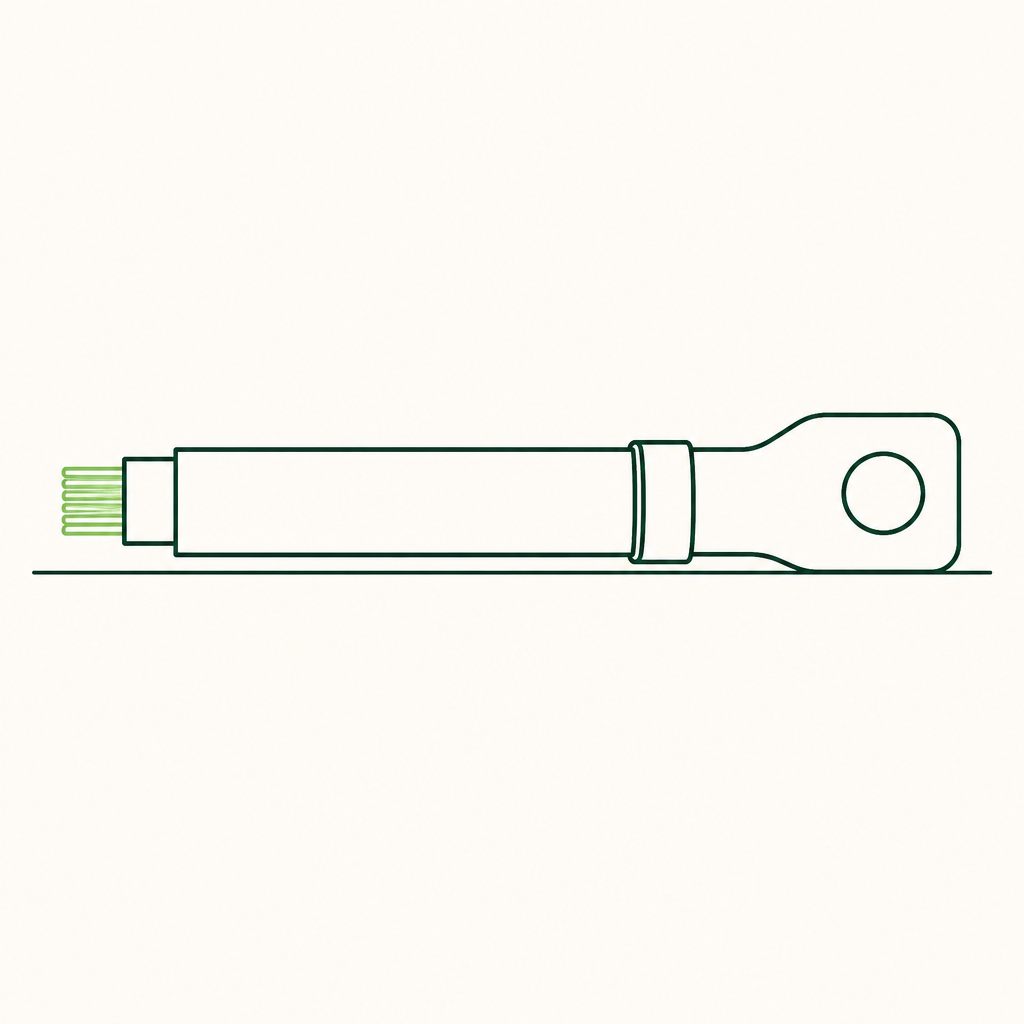
The skin does very little electrically. Current divides according to resistance, and aluminium has roughly 1.6 times the resistivity of copper, so most of the current travels in the aluminium core rather than in the cladding around it. The cable therefore behaves like an aluminium cable of the same size, at very close to an aluminium cable's resistance.
What that does to a 12V system
- Voltage drop, which is the one that shows up first. The volts lost in a cable are the current multiplied by the cable's resistance, and the resistance is decided by the material, the gauge and the length — twice the length is twice the drop, and so is an extra 60% of resistivity.
- Heat, because the energy lost in the cable becomes warmth in the cable. A joint that is warm to the touch under load is already telling you the resistance is too high.
- Current that never arrives. A load that needs a certain number of amps at a certain voltage will draw what the cable can deliver, and an undersized run means a charger charges more slowly, an inverter cuts out early, or a battery never reaches full charge.
- A gauge that has to be upsized. If you do use CCA, the cable has to be one or two gauges heavier than the copper cable it replaces, which usually removes the saving.
The arithmetic is worth doing rather than guessing. Work out the maximum current the cable will carry, decide the maximum voltage drop you are willing to accept, and choose the cable from there; the cable and fuse sizing guide on this site walks through the calculation for a 12V system.
The joint is where it fails
Aluminium reacts with air to form an oxide layer that is a poor conductor, and it forms immediately on any freshly cut end. Under a lug or a set-screw terminal, that layer means the contact is made through a film rather than metal to metal, and the joint runs warmer than it should. Warmth accelerates oxidation, which raises the resistance further, and the joint loosens over time — the sequence behind a burnt terminal.
Two things help. A cable whose outer jacket is tin-plated resists corrosion along its whole length, and a crimped joint covered by heat-shrink keeps moisture out of the barrel so the strands cannot oxidise inside it. Both are worth checking for on any cable you buy, whichever conductor it uses.
What good cable looks like
- A pure copper conductor, and fine strands rather than a few stiff ones. Fine stranding is what allows the cable to bend and to tolerate a vehicle's vibration without work-hardening and cracking.
- Insulation rated for the environment it lives in, with an outer jacket that resists damp and abrasion.
- Ring terminals that are the right size for the stud they will sit on, crimped rather than soldered, with heat-shrink over the barrel.
- A length made to measure for the run, because a loop of surplus cable is added resistance and a place for a fault.
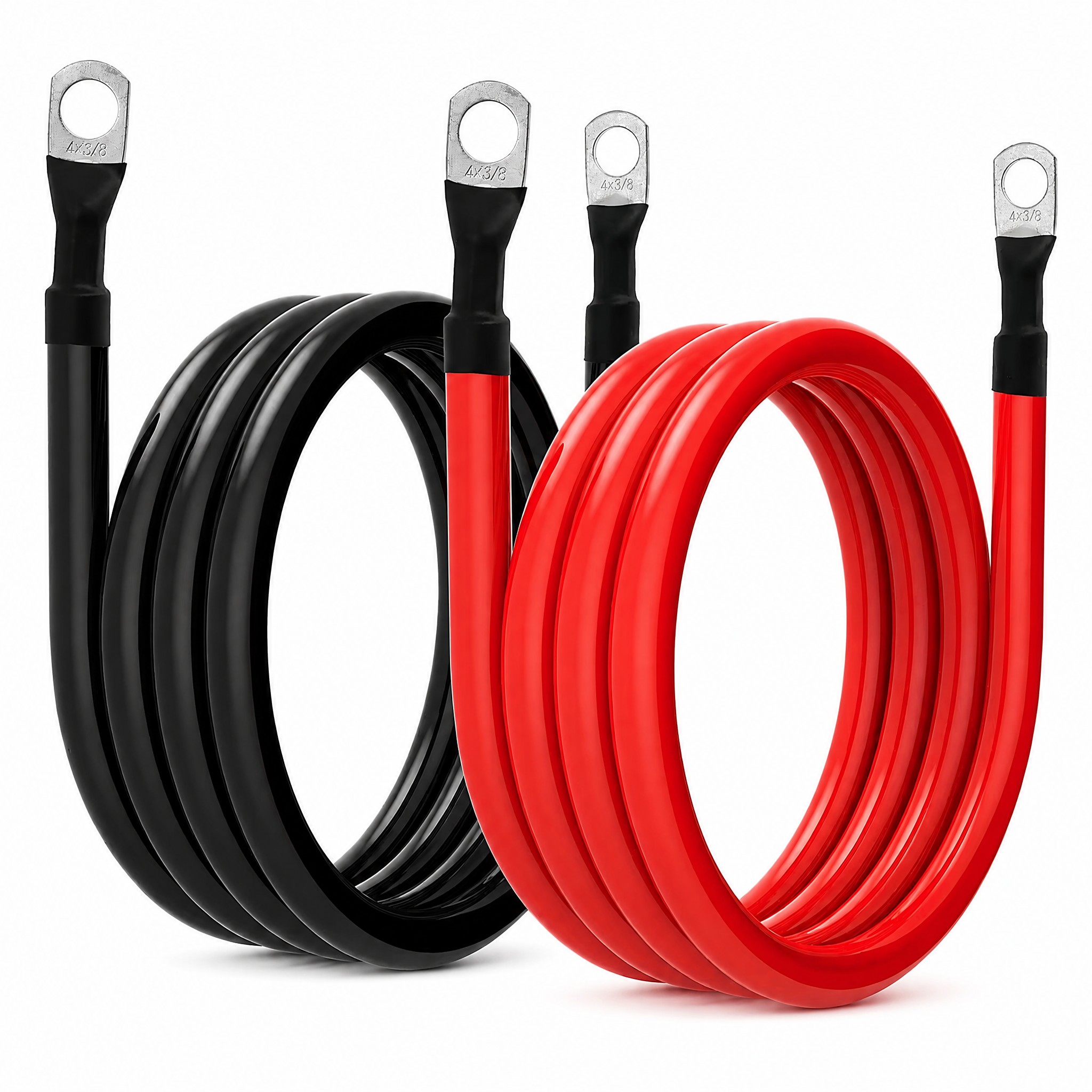
SUYEEGO's battery cable is 4 AWG pure copper, insulated in PVC with a tin-plated jacket, and supplied as a red and black pair with 3/8 inch (9.5 mm) ring terminals and heat-shrink already fitted, cut to the length you ask for. It is the same cable used to wire the rest of the range, from the battery to the inverter as well as to the charge controller and the battery bank itself.
Frequently asked questions
- Is CCA cable safe to use?
- It is not unsafe if it is upsized to carry the current, but it is the wrong choice for a high-current 12V run to an inverter or a battery bank, where the resistance turns into voltage drop and heat. Where a short, low-current connection is all that is needed, CCA is a reasonable economy.
- How do I tell copper cable from CCA?
- Cut or snip an end. A copper cable shows copper all the way through; CCA shows a silvery aluminium core inside a thin copper skin. Weight gives it away as well, since aluminium is much lighter for the same gauge.
- Does the gauge matter more than the conductor material?
- Both matter, and they trade against each other: a heavier CCA cable can carry the current that a lighter copper one carries. Choosing by gauge alone is where the mistake usually starts, because the gauge number says nothing about what the conductor is made of.
- Is tin-plated cable worth having?
- Where the cable lives somewhere damp, or anywhere a joint will be exposed to condensation and road spray, yes. The plating slows the corrosion that raises resistance at terminals and lugs, which is the failure that ends a cable's life in practice.