
What does a lithium battery's voltage tell you?
6 min read
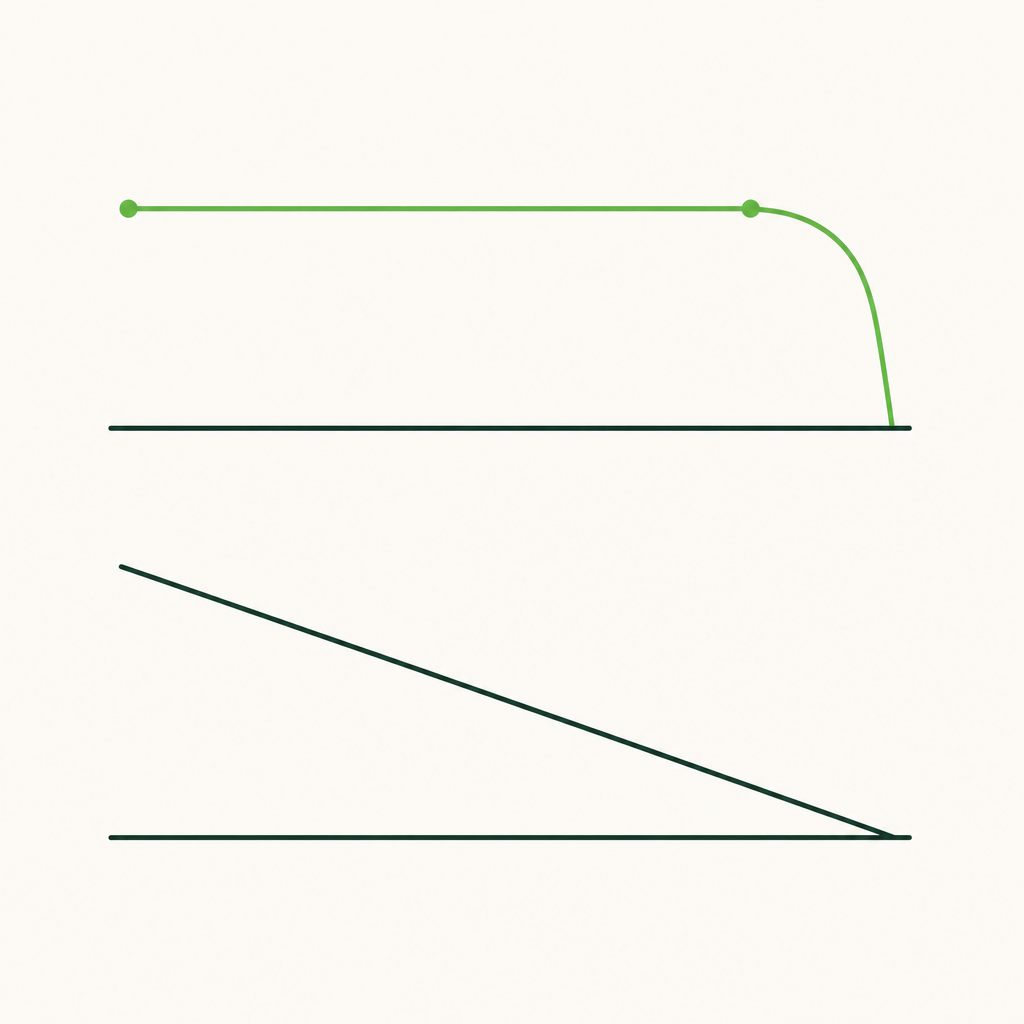
Less than most people expect. A lead-acid battery's voltage falls steadily as it discharges, which is why a voltmeter has always been a usable fuel gauge on one; a LiFePO4 battery holds a nearly flat voltage across most of its range and then falls away quickly at the end, so 12.9V, 12.8V and 12.7V can all describe a battery that is anywhere from comfortably full to nearly empty. The readings worth trusting are the ones taken with nothing connected and nothing charging, and the two figures worth memorising are the ones the data sheet publishes: 12.8V nominal, and a charge voltage of 14.40–14.60V.
Why the curve is flat
The flatness is a property of the chemistry rather than a fault in the battery. It is also the reason the same voltmeter that works well on a lead-acid bank tells you so little here: in the middle of the curve a large change in how much energy is left barely moves the needle.
That has one practical consequence worth taking seriously. Because the voltage stays high until the battery is nearly empty, the only warning you get is a short one. A system that is used until the voltage starts to fall is a system that is used until it is almost flat, and the capacity figures on the data sheet, 2.56kWh for the 12.8V 200Ah model for instance, are the ones that tell you how much work is actually left.
Four readings, and what each one is worth
| Reading | What it is worth |
|---|---|
| Resting voltage, nothing connected | A rough idea only. The flat middle of the curve covers most of the state of charge, so a healthy-looking number is not evidence of a full battery |
| Voltage while charging | Useful. A 12.8V LiFePO4 battery should be seeing 14.40–14.60V at its terminals if the charger is doing its job |
| Voltage under a heavy load | Almost nothing about charge, and quite a lot about cable, connections and internal resistance. A low reading here is more often a voltage drop than an empty battery |
| Voltage immediately after charging stops | Not meaningful yet. The surface charge has to settle before the reading means anything |
What a low reading probably means
- Something is still connected. A parasitic draw left running drains a battery with no obvious load, and the reading falls with it.
- The battery is genuinely close to empty, and the flat curve is doing exactly what it does — hiding the approach to the end.
- The battery's management system has cut off the discharge, which is a protection working rather than a fault.
- It is cold. A cold lithium battery has a higher internal resistance, so its voltage sits lower under the same load and recovers as it warms.
- There is a bad joint between the battery and the meter. A loose or corroded connection drops volts under load and looks like a failing battery.
What to watch instead
If you need to know how much is left, count the energy rather than read the voltage: a shunt-based monitor measures everything that leaves the battery and everything that goes back in, and reports a state of charge from the difference. It is the instrument that answers the question directly, because it does not depend on the shape of the discharge curve.
Short of that, the useful figures are the ones a controller or charger already reports over a whole day — how much energy went in, and how long the load ran — together with the two current limits that decide whether a plan is realistic: what the battery will accept while charging, and what it will deliver continuously.
The figures this battery publishes
SUYEEGO's 12.8V 200Ah LiFePO4 battery stores 2.56kWh, carries an intelligent BMS, and is rated for 200A of continuous discharge and 100A of charging current, with a published charge voltage of 14.40–14.60V and more than 6000 cycles. The BMS is there to protect the cells rather than to act as a fuel gauge: for state of charge, fit a shunt monitor, or size the system so that it does not need one.
Frequently asked questions
- What voltage is a fully charged LiFePO4 battery?
- There is no single number that answers the question usefully, which is the point of the flat curve. The published figure that matters is the charge voltage the battery should be brought to, 14.40–14.60V for this chemistry; after that its resting voltage settles back to something only a little above a half-full battery's reading.
- Why does my battery read a healthy voltage but run for only an hour?
- Because voltage is not a fuel gauge on lithium. A battery part-way down a flat curve reads much the same as a full one; what has changed is the energy left, not the volts. Work out the energy the loads use instead, or fit a shunt monitor.
- Can I use voltage to decide when to recharge?
- Not reliably. By the time the voltage falls noticeably the battery is nearly empty, and that is a poor place to plan a recharge from. Recharge on energy used, or on a routine, rather than on the voltmeter.
- Does a low voltage mean the battery is damaged?
- Usually not. A load still connected, a cut-off, cold weather or a poor connection all produce the same reading. Disconnect everything, let it settle, and measure at the terminals before concluding anything about the battery itself.