RV solar system kit, or parts bought separately?
7 min read
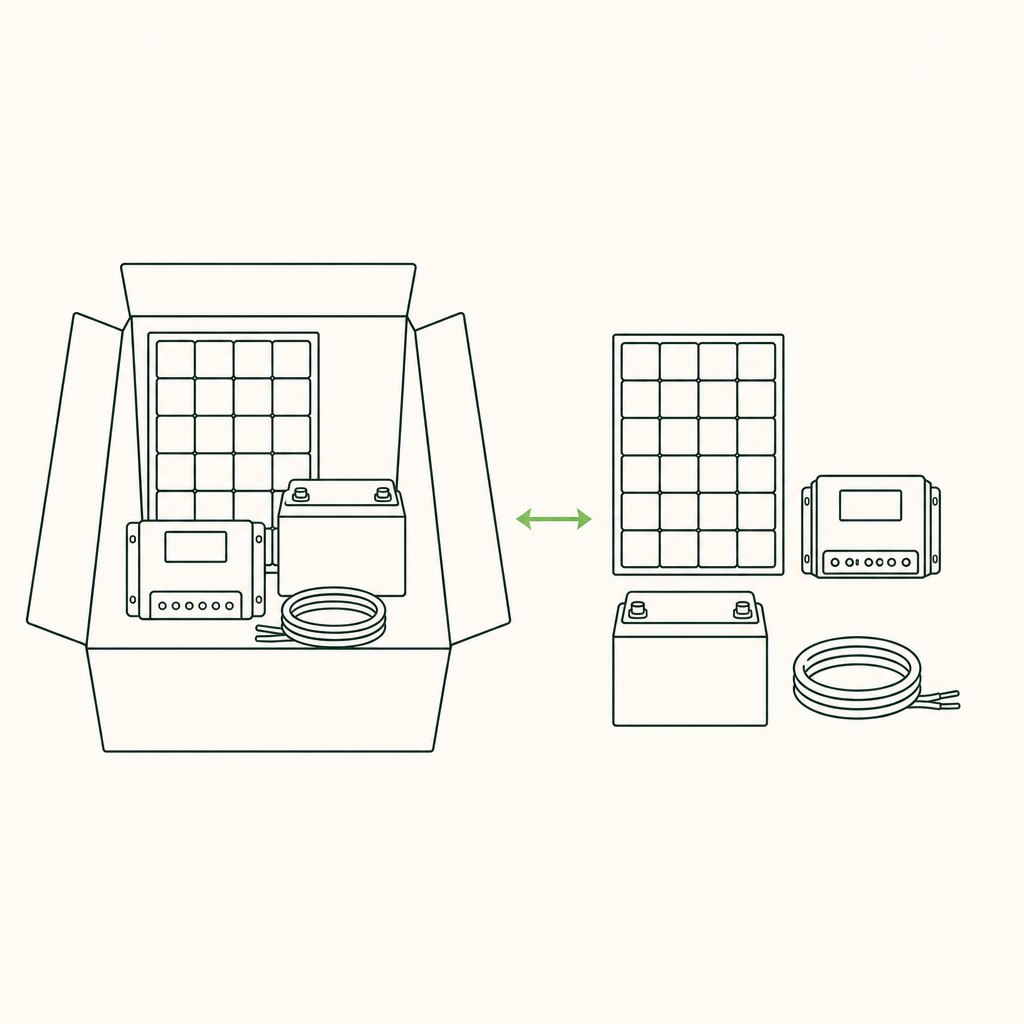
Buy a kit when its sizing already matches your daily energy use and it contains the parts you would have chosen anyway; buy separate parts when you are extending an existing system, working around an unusual roof, or need a rating the kit does not offer. What decides it is the parts list rather than the discount, because many kits stop at the panel, controller, battery and inverter and leave cable, fuses, mounting and roof entry to the buyer.
What a kit is actually for
A kit is a matched set for a typical use case: a certain daily energy use, a certain roof, a certain system voltage. Its real value is not the discount but the fact that the connectors, voltages and ratings have been made to fit one another before you see them, which removes a class of mistake that is easy to make when buying piece by piece.
That value only holds while your case is the typical one. The moment your daily use, roof or battery differs from the kit's assumption, you are buying the mismatch along with the parts.
What kits usually leave out
The main four components are what a kit advertises, and usually what it contains. The items below are what an installation needs beyond them, and they are frequently absent.
- Cable cut to the actual run length, in the gauge the current requires
- A fuse or breaker at the battery terminal, with a holder rated for DC
- Mounting: brackets for framed panels, or adhesive and primer for a flexible one
- Roof entry gland and sealant, where the cable passes through the shell
- MC4 extension leads long enough to reach from the roof to the controller
- A shunt or battery monitor, if you intend to know the state of charge rather than infer it
- Crimping tools, and the labour to install any of it
The four ratings that have to line up
Whichever route you take, four pairs of ratings decide whether the parts work together. A kit gets these right by construction for its intended case; buying separately means checking them yourself.
| Pair | What goes wrong when it does not line up |
|---|---|
| Panel open-circuit voltage at the coldest expected temperature against the controller's maximum PV voltage | The controller is destroyed on the first cold, bright morning, when panel voltage rises above its rating |
| Array short-circuit current against the controller's current rating | The controller runs at its limit and derates or shuts down on the best days of the year |
| Inverter continuous watts against the battery's continuous discharge current at system voltage | The battery's protection trips under a load the inverter is happy to supply |
| Expected current against cable ampacity, and cable ampacity against the fuse | The fuse protects the cable in theory only; in practice the cable overheats before the fuse acts |
When separate parts are the better buy
- You are extending a system that already exists, and the kit would duplicate a controller or a battery you have
- Your roof is unusual: a pop-top, a curved shell, or a layout that fits one large panel better than several small ones
- You want a specific controller because of its voltage window, its load output, or its monitoring
- You are building at 24 V, which many van kits do not cover
- The run from roof to controller is long, and the cable in the kit is not long enough or thick enough
- One component has failed and the rest of the system is sound
When the kit is the better buy
- It is your first system and its sizing matches your measured daily use
- The vehicle is a standard van with a flat roof area and no unusual constraints
- You value one order, one delivery and one warranty over the last few percent of optimisation
- The kit's parts are the ones you would have chosen anyway, which you can confirm from the ratings rather than the marketing
Six questions that apply either way
- What is the array's open-circuit voltage at my coldest temperature, and what is the controller's maximum PV voltage?
- What continuous current will the inverter draw from the battery, and what is the battery's continuous discharge rating?
- What gauge is the cable, is it copper or copper-clad aluminium, and how long is the run?
- Is there a fuse at the battery terminal, and is its holder rated for DC?
- Does the total include mounting, roof entry and connectors, or are those extra?
- If I add a second panel or a second battery later, what has to be replaced?
Frequently asked questions
- Are RV solar kits worth it?
- They are worth it when the kit's assumed daily energy use matches yours and its parts are the ones you would have picked. They are poor value when the sizing is wrong for your use, because you then pay for the mismatch as well as for the parts.
- Do kits include everything needed to install?
- Rarely. Most include the panel, controller, battery and inverter, and stop there. Cable, fuses and holders, mounting, roof entry and connectors are usually separate purchases, and they have to be budgeted for whichever route you take.
- Can I add parts I already own to a kit?
- Sometimes, but check the ratings of the part you already own against the kit's components before ordering. Mixing a controller from one source with a panel from another is how systems end up with an array the controller cannot fully use.
- Is a larger kit always better value?
- No. A larger kit is better value only if your daily energy use justifies it. An oversized array on a battery that cannot store the output simply reaches full charge earlier in the day and then produces nothing useful.