What size DC DC charger do I need for a leisure battery?
7 min read
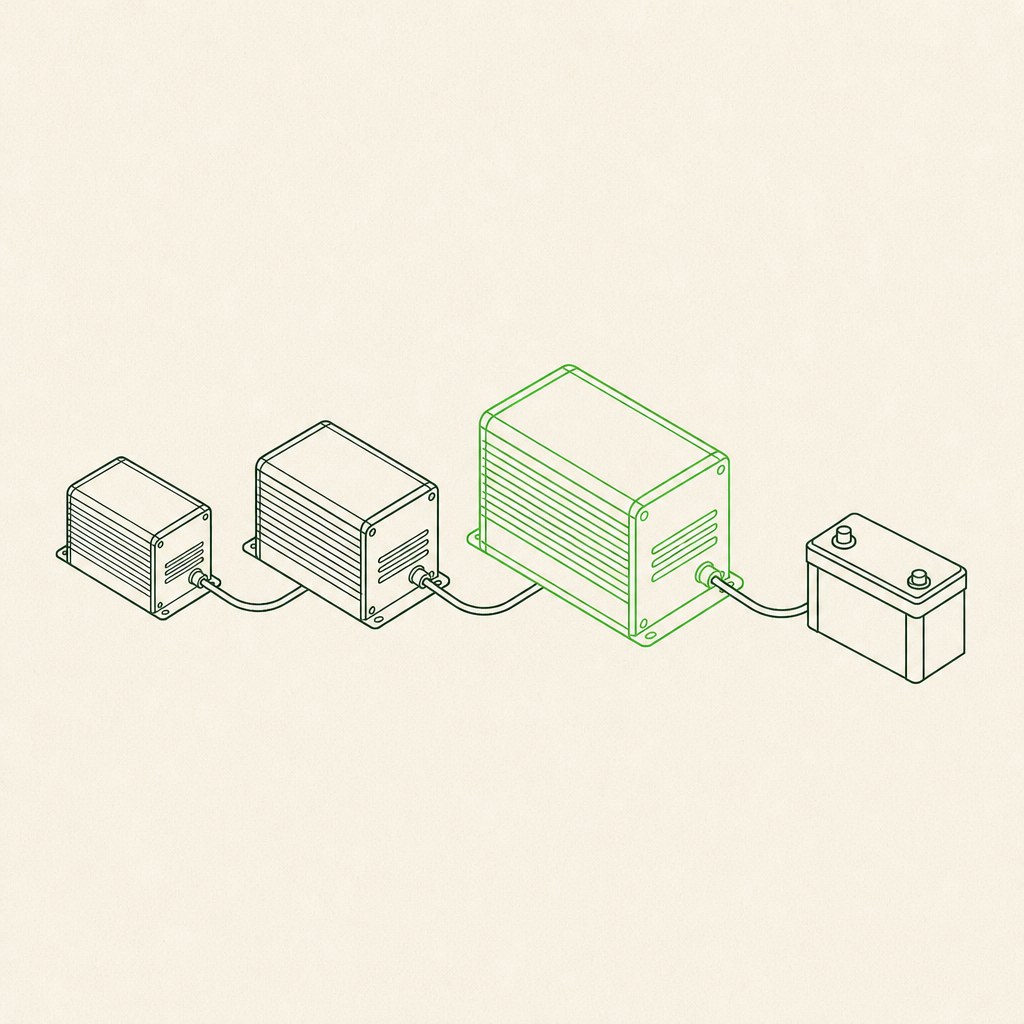
Work from the battery rather than from the vehicle. A charger can only deliver what the battery will accept at that moment, so a larger unit does not force a larger current into a battery that is full, cold or already near its acceptance limit. The practical question is how quickly you want to replace what you use, answered against the published options: 20A, 30A, 40A and 60A on the 12V range, and 40A or 60A on the DD range.
The battery sets the ceiling
Charge current is not something a charger decides on its own. It is the result of a voltage the charger applies and the current the battery accepts in response, and that acceptance changes with chemistry, state of charge and temperature. A nearly full lithium battery and a cold one both take far less than the same battery does when it is half empty and warm.
That is why the battery's own data is the authority on the upper limit, and why we do not publish a recommended ratio of charge current to bank capacity. Two banks of the same amp-hour rating can have completely different acceptance limits, and quoting a single percentage would be inventing a figure that the battery manufacturer has not agreed to.
What the 12V range offers
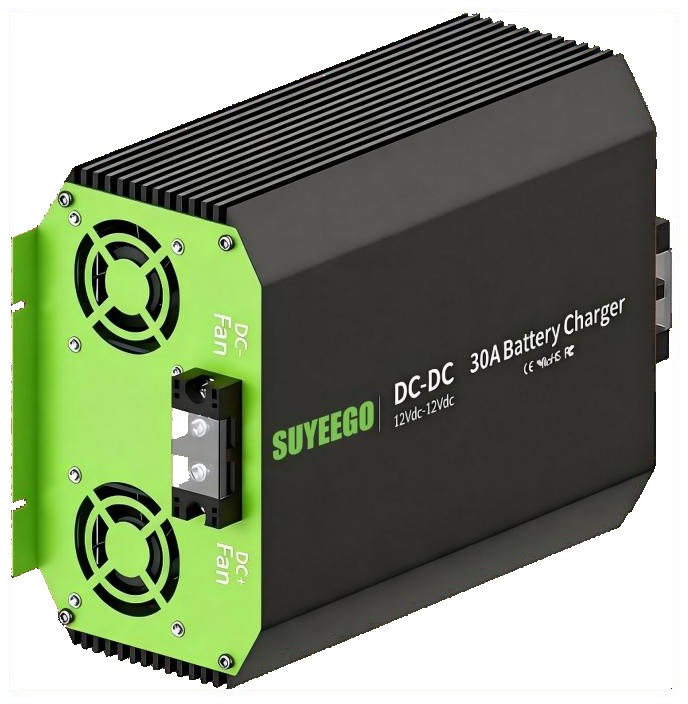
The 12V range is published as four models, and each one pairs a charge current with an output power. Both figures describe the same unit from different angles, and the output power is the one that matters when you are comparing what the charger asks of the vehicle.
| Charge current | Output power |
|---|---|
| 20A | 250W |
| 30A | 360W |
| 40A | 500W |
| 60A | 750W |
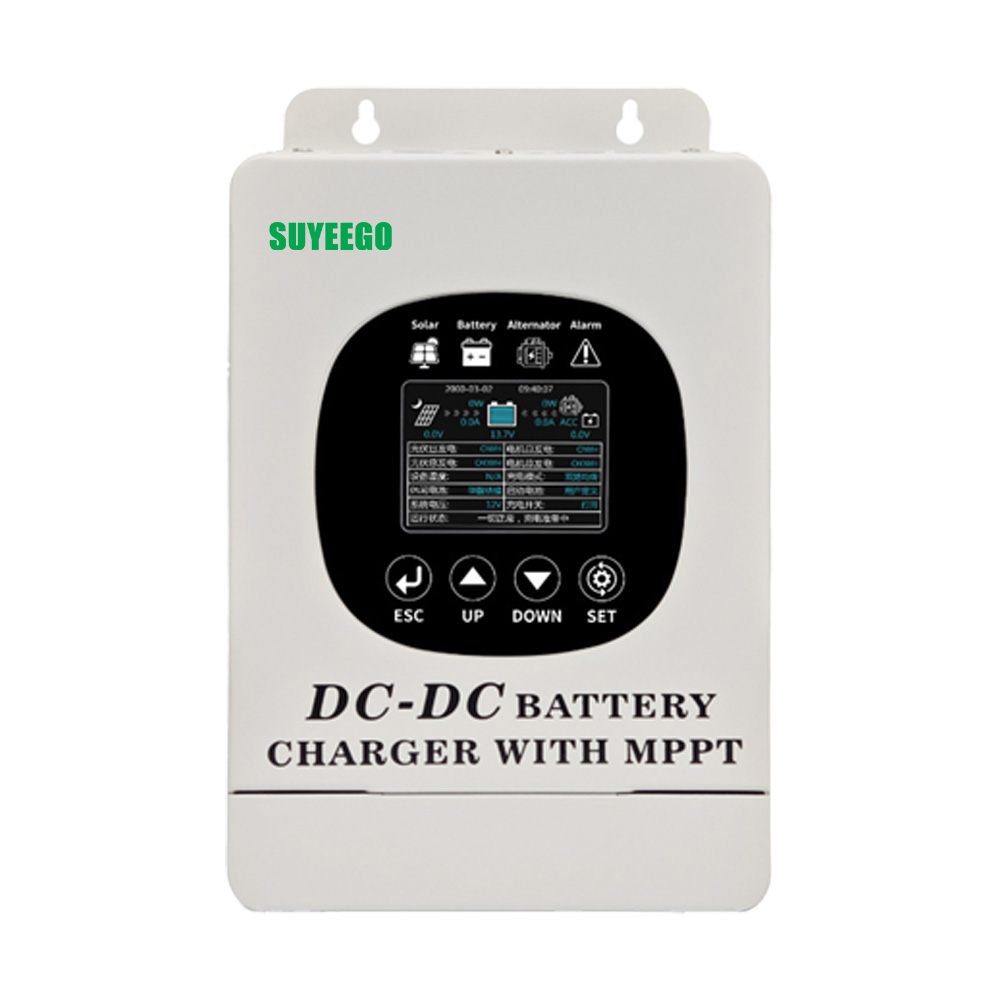
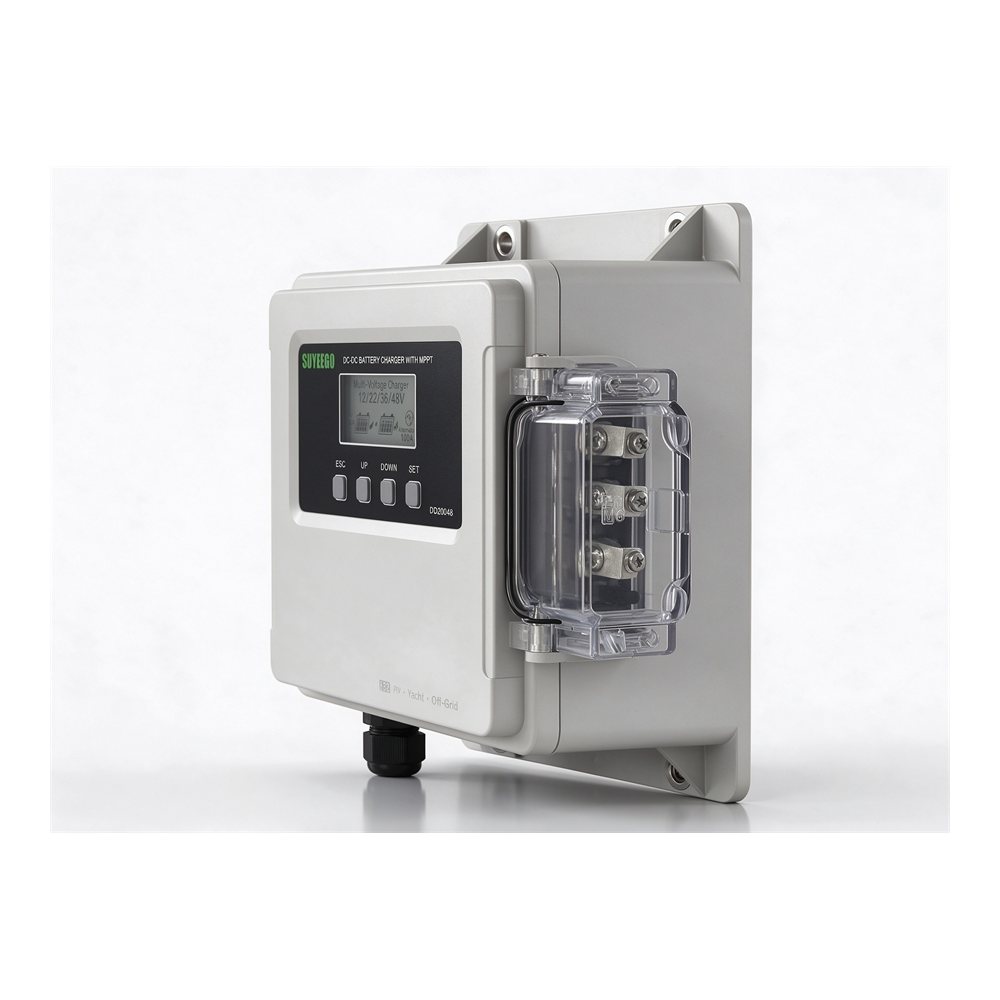
The DD range covers a narrower, higher part of the same ground: 40A or 60A of maximum charge current, across a leisure battery voltage range of 9V to 60V. It exists for installations that want the alternator and the solar array feeding the same bank through one box rather than two.
Charge time is the other half of the question
The reason to want a bigger charger is almost always time, and the arithmetic is easy to state and easy to over-trust. A 60A unit, on a bank that will accept 60A, puts back 60 amp-hours in an hour of driving. The same hour at 20A returns a third of that. The complication is that the first figure only holds while the battery is accepting everything the charger can give.
- The bulk phase is the part where the charger's rating is the limit, and it is the part that fills most of the capacity.
- The absorption phase that follows is limited by the battery, not by the charger, so a 40A and a 60A unit can spend a similar amount of time there.
- A short daily drive spends nearly all of its time in bulk, which is where the larger unit earns its place.
- A long drive reaches absorption either way, so the difference between the two sizes narrows as the journey gets longer.
Do not size past the vehicle
The other end of the charger has limits too. The 12V range publishes a nominal input of 12V with an input window of 8V to 16V. The DD range publishes its generator side separately, with a maximum generator input voltage of 80V and a maximum generator input current of 20A across generator system voltages of 12V, 24V, 36V and 48V.
How much spare capacity your alternator has is a question about your vehicle rather than about the charger, and it is the one worth settling before choosing the larger model. We cover the alternator side of that decision in its own guide.
What we do not publish
We publish charge current and output power for both ranges. We do not publish a charge-acceptance curve for either, a recommended ratio of charge current to battery capacity, or a table that maps a bank size to a model. Those would be our numbers standing in for your battery's, and your battery's are the ones that govern.
Frequently asked questions
- Is a bigger DC DC charger always better?
- No. The battery's acceptance sets what actually flows, so a unit much larger than the bank can take buys nothing in the absorption phase and asks more of the alternator throughout. Size for the bulk phase you want and check the vehicle can feed it.
- Can I fit a 60A charger to a small leisure battery?
- The battery will limit the current it accepts, so the charger will not force 60A into it. The real constraints are whether your alternator can supply the input the charger asks for, and what the battery manufacturer permits as a maximum charge current. That last figure is theirs to state, not ours.
- Does a DC DC charger replace a solar charge controller?
- No, they do different jobs. A charger works from the alternator while the engine runs, a solar controller works from the array whenever there is light. The DD range puts both in one unit, with MPPT on the solar input, which is a different product decision from choosing between them.
- Which size charges a 100Ah lithium battery fastest?
- The largest one the battery will accept and the vehicle can feed, which on our ranges means 60A. How much of that the battery actually takes depends on its state of charge and temperature, and we do not publish an acceptance curve that would let us promise a total charge time.