
How should a busbar be laid out in a 12V system?
7 min read

A busbar replaces a stack of ring terminals on one battery stud with a single solid connection point for each polarity. Keep one positive bar and one negative bar and keep them apart, take the heavy feeds to the bar rather than to the battery post, and fuse each feed where it leaves the bar. The battery's own fuse stays on the battery side of the bar, so the bar itself is downstream of protection rather than ahead of it. Size the bar for the current that can flow through it in a fault, not for the sum of the loads you have fitted today.
What it replaces, and why the stack was a problem
A battery post is a single stud. Every cable that needs to connect to it has to share that stud, and they rarely share it well: the heavy cable goes on first because it was there first, the charger lands on top of it, the controller on top of that, and the last terminal in the stack is held by a nut that is compressing four other joints before it reaches anything solid.
The result is a connection whose quality depends on the order things were fitted and on how hard the last person tightened the nut. A busbar removes that variable. Each circuit gets its own stud or its own place on the bar, and the torque on one terminal stops affecting the others.
Two bars, never one shared common
The positive and negative sides need separate bars. A single bar used as a common point for both polarities is a short circuit with a mounting bracket, and it is the kind of mistake that only shows itself when something metallic touches the bar or when a terminal is fitted to the wrong stud.
Where the fuse goes in the chain
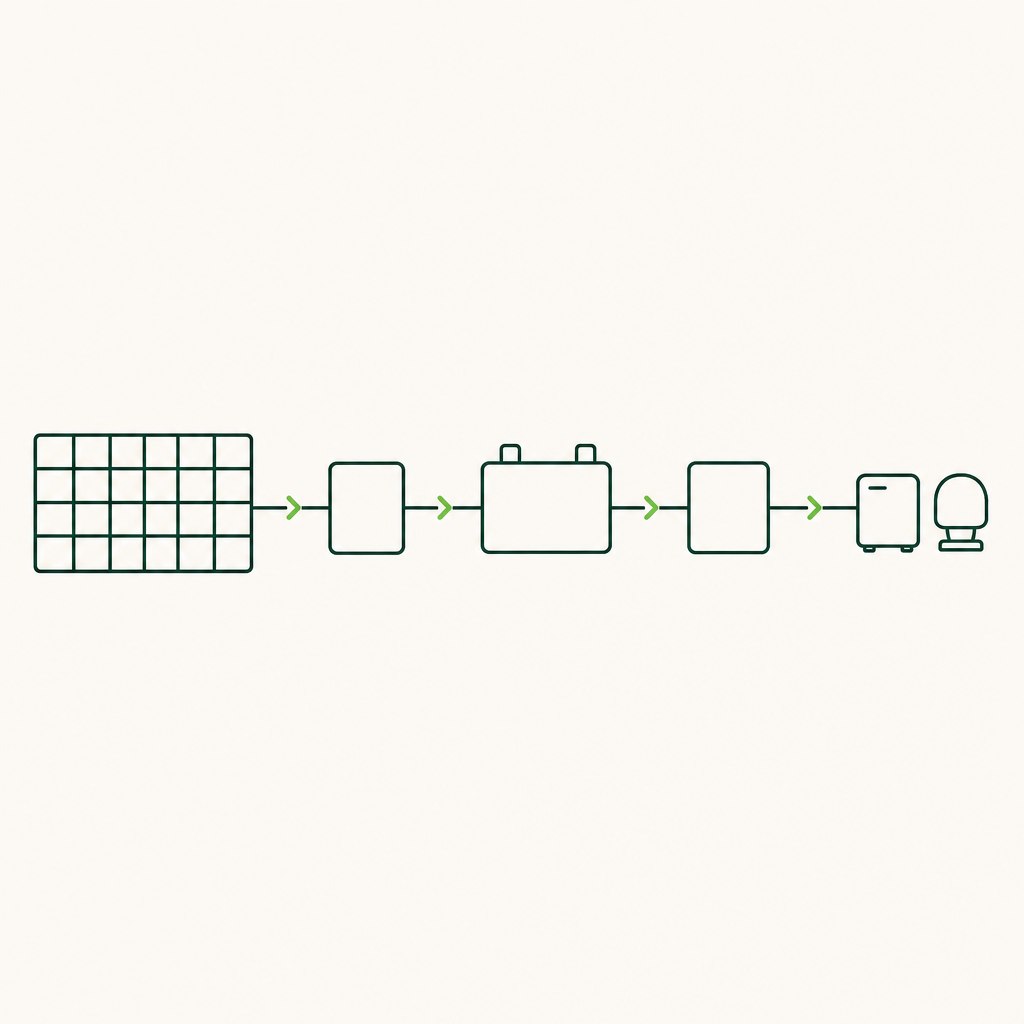
- The battery main fuse sits on the positive cable between the battery terminal and the positive busbar. The bar is then downstream of protection.
- Each heavy feed leaving the bar is fused at the bar, sized above that device's maximum draw and below the cable carrying it.
- Each branch circuit is fused or breakered at the distribution point it leaves from, not at the appliance.
- A charger or controller feed is protected on its own, because it can deliver current as well as receive it.
The pattern is the same at every step: protection goes at the source end of the cable it protects. A fuse at the load end leaves the whole run unprotected, which is precisely the run most likely to be damaged.
Sizing the bar
A busbar has a current rating, and it is not the sum of the fuses attached to it. It is the total current that can flow through the bar at once, which on the battery side means everything that could draw at the same time plus whatever the battery can push into a fault. A bar rated for less than that will run warm at best, and at worst it becomes the fusible link nobody intended to fit.
On a 12V system with a 2000W inverter, the inverter alone draws roughly 185A at the battery end, and that current passes through the bar on its way to the inverter. Add a charger and a controller working at the same time and the bar is carrying more than any single device's rating. Choose the bar for the total, and choose the stud size so the heavy lugs land properly rather than sitting on a stud that is too short for them.
Order and torque on the bar
- Put the incoming battery cable on its own stud where the bar allows it, so the main current path does not run through a stack of smaller terminals.
- Group the heavy feeds together, closest to where the battery cable lands.
- Keep one terminal per stud unless the stud and nut are long enough to compress the stack properly.
- Torque to the figure the hardware calls for, and check it again after the first few weeks of use. Copper settles.
- Use stainless fasteners and a thin film of dielectric grease on the joint faces, so the connection does not become a corrosion site.
The negative side and the shunt
If the system has a battery monitor, its shunt belongs between the battery negative terminal and the negative busbar. Every current in and out of the battery then passes through the shunt, which is the only arrangement in which the monitor's reading means anything. A shunt fitted to one branch, or to the charger side only, measures a fraction of the traffic and reports it as the whole.
The negative bar itself carries the same current as the positive one, so it gets the same rating. It is easy to treat the negative side as the return path that needs less thought; it carries exactly the same current and has exactly the same ability to heat up.
The parts this range uses
The cable and terminals on a SUYEEGO system are published: 4 AWG pure copper with PVC insulation and a tin-plated jacket, terminated in 3/8 inch (9.5 mm) ring terminals with heat-shrink fitted, supplied as a red and black pair in customizable lengths. The 12.8V 200Ah LiFePO4 battery is rated for 200A of continuous discharge and the inverters run from 1kW to 3kW with a peak rating twice their continuous figure, so the bar on the battery side is a 200A-class part before the inverter has asked for anything. That is the number to size it against.
Frequently asked questions
- Can one busbar serve both positive and negative?
- No. A single bar used for both polarities is a short circuit waiting for a connection between the two. Use one bar for positive and a separate bar for negative, mounted so that nothing can bridge the two.
- Does the battery fuse go before or after the busbar?
- Before it, on the positive cable between the battery terminal and the bar. That way the bar and everything attached to it are downstream of protection. A fuse after the bar leaves the bar itself unprotected.
- How do I rate a busbar?
- At the total current that can flow through it, which includes simultaneous loads plus what the battery can deliver into a fault. It is not the sum of the fuse ratings on the branches, and it is not just today's load list.
- Where does a battery monitor's shunt belong?
- Between the battery's negative terminal and the negative busbar, so that every current entering or leaving the battery passes through it. Anywhere else and the monitor is measuring a part of the system while presenting it as the whole.