Should you use 12V or 24V solar panels with an RV MPPT solar charge controller?
5 min read
With an MPPT controller the panel's nominal voltage does not have to match the battery's, so a 12V battery can be charged from panels whose label says 24V or higher. That freedom is why the question is really about the string's open-circuit voltage rather than about the panel's nominal figure: what matters is that the string stays under the controller's published open-circuit voltage limit for your bank voltage, including the rise that happens in cold weather.
Why MPPT breaks the link between panel and battery voltage
A PWM controller works by connecting the array to the battery and letting the two settle around a common voltage, so the array has to be built for the battery it is charging. An MPPT controller instead runs the array at the voltage where it produces most power and converts that down to the battery voltage. Because there is a conversion stage in between, the array voltage and the battery voltage are independent design choices.
In practice that means the useful question is not 'what voltage does the battery need' but 'what string voltage will this controller accept'.
The published open-circuit voltage ceilings
Our range publishes its maximum open-circuit voltage per bank voltage, and the ceiling rises with the bank. For the 20A model the 12–24V bank ceiling is 80V; for the 30A model it is 80V–105V; from 40A up it is 130V on a 12–24V bank. On a 48V bank the ceiling is 180V across the range. On a 96V bank it is 180V on the 20A and 30A models and 280V from 40A up.
| Bank voltage | Published open-circuit ceiling |
|---|---|
| 12–24V | 80V (20A) · 80V–105V (30A) · 130V (40A and above) |
| 48V | 180V across the range |
| 96V | 180V (20A, 30A) · 280V (40A and above) |
The number that catches people out
Panels are rated with an open-circuit voltage measured at standard test conditions, which specify a cell temperature of 25 °C. On a cold morning the same panel produces a higher open-circuit voltage, because a silicon cell's voltage rises as it cools. For an RV that is used in winter, the coldest expected panel temperature — not the summer one — is the figure to design against.
This is the reason a string that sits comfortably under the ceiling in July can be the one that trips overvoltage protection in January. The panel's own datasheet usually gives a temperature coefficient for open-circuit voltage that lets you work out the cold-day figure, and that cold-day figure is the one to compare with the ceiling above.
Our published operating temperature range is −15 °C to 65 °C, which is the environment the controller itself is rated for. It is a separate figure from the array voltage question and does not extend the open-circuit allowance.
Higher string voltage, thinner cable
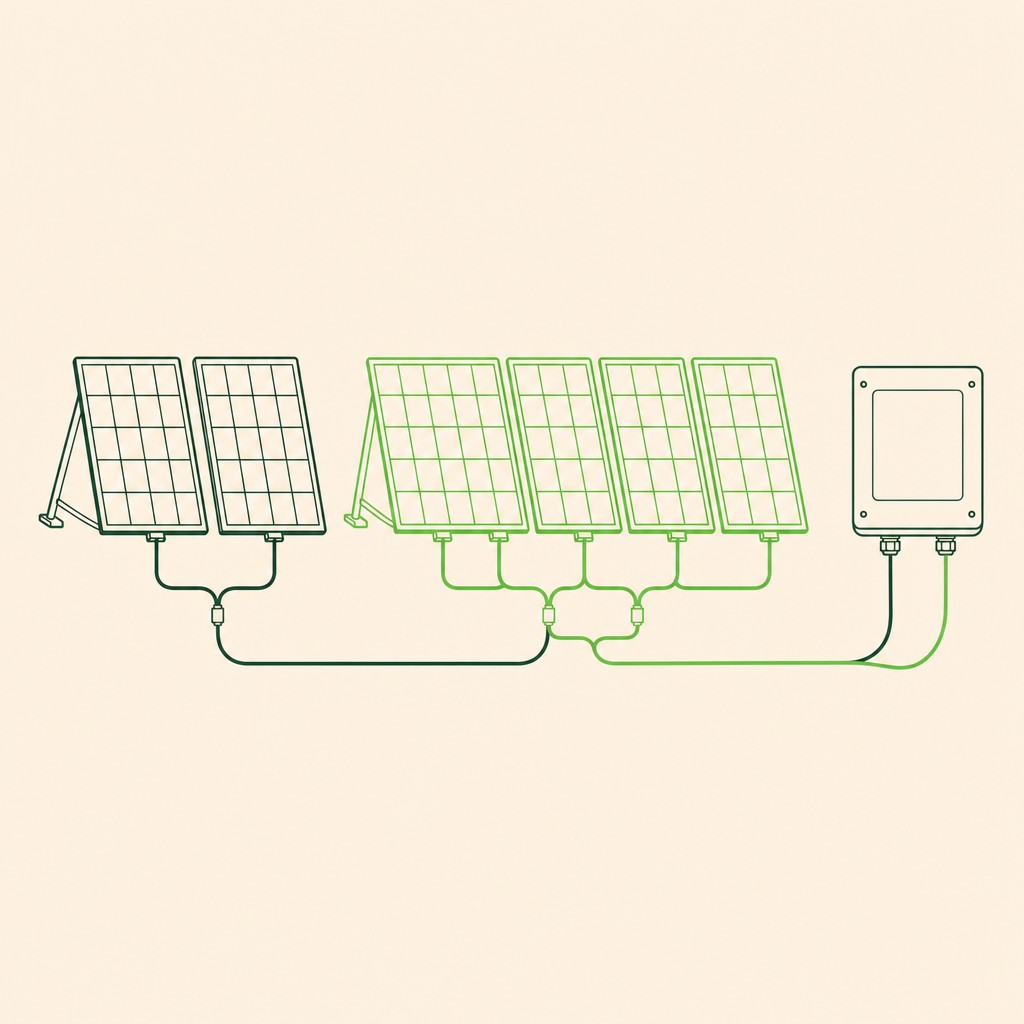
There is a second reason to run panels in series rather than in parallel. For a given wattage, a higher-voltage string carries less current, and less current means less voltage drop over the same cable and a smaller conductor for the same run. On a van, where the run from roof to controller is long and the space for cable is tight, that is often the deciding practical factor.
The trade-off is partial shading. Panels in series share a current path, so shading one panel in a series string costs more of the array's output than shading one panel in a parallel arrangement. The choice between the two arrangements, and what optimisers change about it, is covered in the guide on whether shaded panels need DC optimisers.
Frequently asked questions
- Can I charge a 12V battery from a 24V panel with an MPPT controller?
- Yes. An MPPT controller converts the array's voltage down to the battery voltage, so the panel's nominal voltage does not have to match the battery. What has to be checked is the string's open-circuit voltage against the controller's published ceiling for the bank voltage you are using.
- Should I design against the panel's rated open-circuit voltage?
- No. The rated figure is measured at a cell temperature of 25 °C. On a cold day the open-circuit voltage is higher, so the array should be designed against its cold-weather figure rather than the datasheet's standard-conditions number.
- Does a higher bank voltage let me run a higher array voltage?
- On our range, yes. The published open-circuit ceiling is 80V to 130V on a 12–24V bank depending on the model, 180V on a 48V bank, and up to 280V on a 96V bank. The ceiling is published per bank voltage rather than as one figure for the whole range.