
Why is my RV MPPT solar charge controller charging below the target voltage?
6 min read
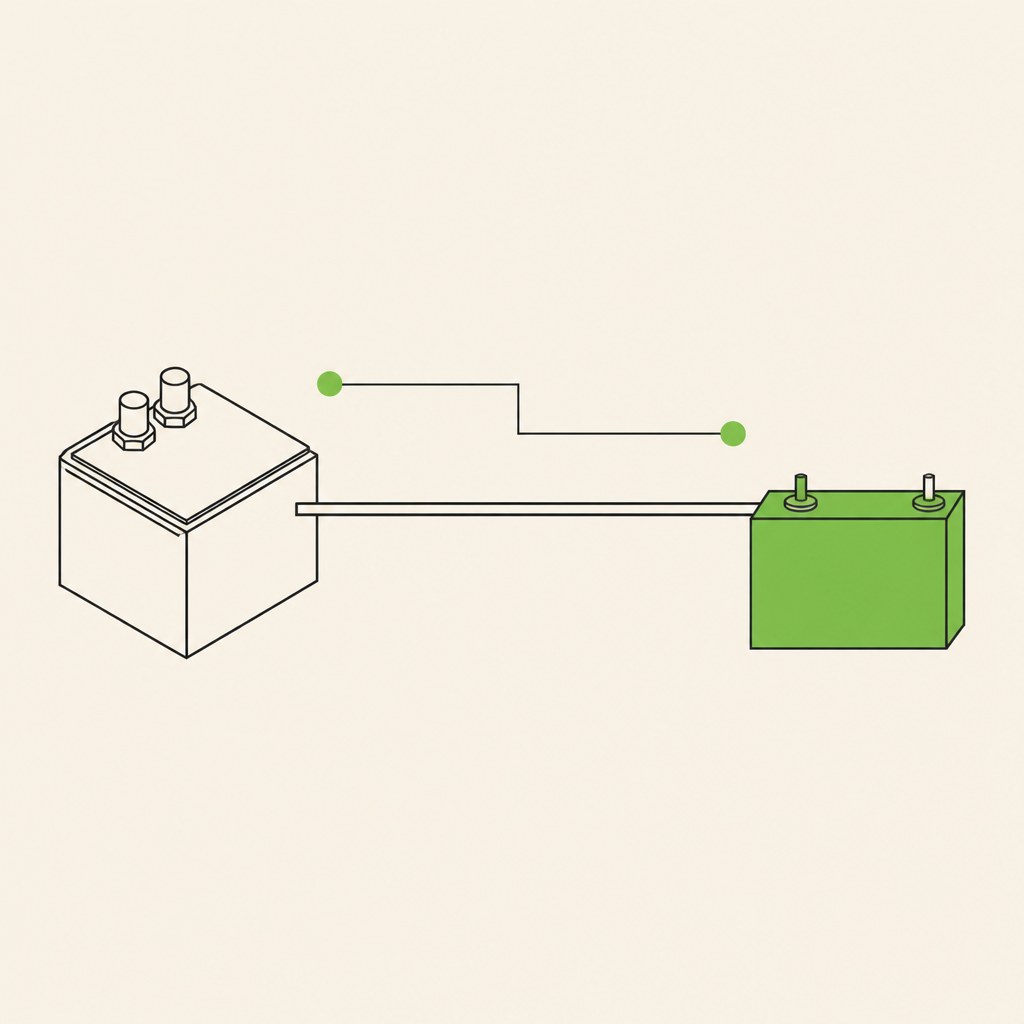
Because the controller regulates the voltage at its own terminals, not at the battery posts. If the cable between the two drops voltage under load, the battery receives less than the controller is holding, and the controller has no way to notice: as far as it is concerned the target is being met. The gap is a wiring problem rather than a settings problem, and it grows with charge current.
The controller holds the voltage where it measures it
A charge profile is a set of target voltages, and the controller works to hit them at the point it senses. That point is its own battery terminals. Everything beyond those terminals — the cable run, the lugs, any fuse holder, the battery post itself — sits outside the control loop.
Current through a resistance produces a voltage difference. The resistance here is the cable run and its terminations, and the current is whatever the array is delivering. So the difference between the controller's reading and the battery's actual voltage is largest exactly when you would most want it to be small: at high charge current.
Checking for it
The test takes two measurements and no equipment beyond a meter. Do it in good sun, with the array delivering a steady current, because the difference you are looking for scales with current and disappears entirely when nothing is flowing.
- Charge in good sun and let the current settle, so the two readings describe the same conditions.
- Read the voltage at the controller's battery terminals — that is the figure the controller is working to.
- Read the voltage at the battery posts immediately afterwards.
- Compare the two, then watch the gap as the charge current rises and falls. A difference that grows with current points at resistance in the run.
- Inspect the lugs, ferrules and any fuse holder in the run before suspecting the cable itself. One poor joint produces the same symptom as a run that is too thin.
- If the connections are sound and the gap persists at high current, shorten the run or increase the conductor size rather than adjusting the controller.
What the two readings tell you
- A gap that appears under load and closes when the current falls is the signature of resistance in the run rather than a fault in the controller.
- A gap on one connection but not the other points at that connection: a lug that was never properly crimped, a ferrule that loosened, or a fuse holder with a poor contact.
- A gap that is proportional to length, at the same current, points at the cable's cross-section rather than at a joint.
- If the battery is not reaching absorption voltage, the bank itself may be at the end of its useful capacity, which is a different problem and shows up as a low voltage at rest as well as under charge.
What to do about it
Work from the cheapest fix outwards. Re-terminating a suspect lug costs nothing much and cures the fault surprisingly often. If the run is simply long, shortening it or increasing the conductor size is the durable answer. The controller is the last thing to change, because the voltage it holds is the one it was asked to hold, and moving the problem to a different unit will not close a gap that lives in the wiring.
Frequently asked questions
- Why does my battery sit below the controller's absorption voltage?
- The controller holds its target voltage at its own terminals. Voltage lost along the cable and through the terminations means the battery receives less than that. Measure at both ends while charging and compare — a gap that is present under load and closes when the current drops is the cable run rather than the controller.
- Does a long cable run really matter?
- It does, and it matters more as current rises, because the voltage lost is the current multiplied by the resistance of the run. That is why the effect is small at a trickle and obvious at full charge current, and why the controller-to-battery run is worth keeping short.
- Would a different charge controller fix this?
- No. Any controller regulating at its own terminals behaves the same way with the same wiring. The voltage it holds is the voltage it was asked to hold, so if the battery is reading lower, the difference is between the controller and the battery rather than inside the controller.
- Should I raise the target voltage to compensate?
- We would not. The target voltages belong to the battery's own specification, and raising them to offset a wiring loss applies the wrong voltage to the battery whenever the current is low and the loss is absent. Fix the resistance instead.