Can one DC DC charger charge two battery banks?
6 min read
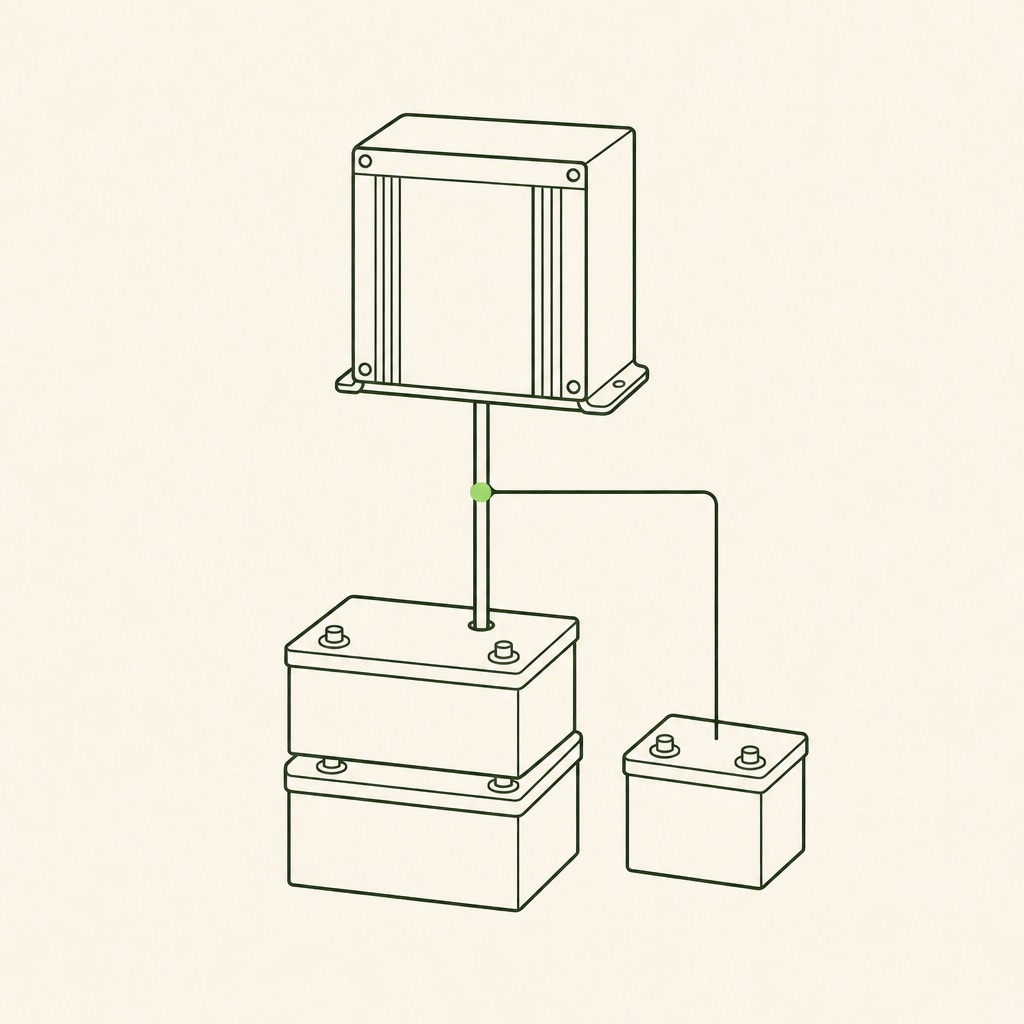
Not as two independent banks. Each unit publishes a single leisure-battery charging output, so two separate banks wired to it are electrically one bank and will equalise into each other rather than being charged individually. The genuine exception is the starter battery: on the DD range the product data publishes a separate PV charging current for the starting battery of 10A or 20A, with the starter battery type given as lead acid, so the vehicle battery can be maintained while the leisure bank charges.
One output, one bank
A charger does not have a notion of which battery it is filling. It holds a voltage at its output terminals and lets current flow. Connect two banks to those terminals and they are, from the charger's point of view, a single bank with more plates in it - and they are also connected to each other, which is the part that matters.
That is fine when the two are identical and permanently paralleled anyway. It stops being fine when they differ. Two banks at different states of charge will pass current between themselves the moment they are joined, and two banks at different voltages will do so hard.
The starter battery is the real exception
The vehicle's own battery is the one case where a second battery genuinely gets its own treatment. On the DD range the product data publishes a PV charging current for the starting battery of 10A or 20A, and gives the starter battery type as lead acid. That is a dedicated maintenance path, not the leisure output shared across two banks.
If the two banks must stay separate
There are legitimate reasons to keep banks apart: one is lithium and one is lead acid, or one lives in the vehicle and one in a trailer that gets left behind. In that case the clean arrangement is one charger per bank, with each charger seeing the battery type and voltage of its own bank.
What we cannot offer is guidance on running two chargers into one bank in parallel, or on splitting one output across two banks through a changeover. Neither is published for our ranges, and unpublished is not the same as supported. The parallel question is worth reading alongside this one, because the two get confused.
Why not just join them
If both banks are the same chemistry, the same nominal voltage and roughly the same age, joining them into one bank is the arrangement the charger was designed for and it removes the problem entirely. Bank capacity then adds up, and the sizing question becomes the ordinary one of how much charge current that larger bank will accept.
Where they differ, joining them is the failure mode rather than the solution. The battery type list is the clue: the 12V range publishes flooded, gel, AGM and lithium as settings, and the DD range publishes sealing, colloid, water addition, LiFePO4, ternary lithium and a custom profile. A single unit applies one of those at a time, so two banks needing different profiles cannot both be served from one output.
What we do not publish
We do not publish a second leisure output, a multi-bank distribution accessory, a split-charging arrangement for one output, or current-sharing figures for two banks on one set of terminals. The published output count is one leisure output plus, on the DD range, the starter-battery maintenance path described above.
Frequently asked questions
- Can I wire a lithium bank and a lead-acid bank to one charger?
- No. They would be connected to each other as well as to the charger, so they would equalise, and only one battery type setting can be active at a time. Two banks that need different profiles need two chargers.
- Does the charger top up the vehicle's starter battery?
- On the DD range the product data publishes a PV charging current for the starting battery of 10A or 20A, with the starter battery type given as lead acid. That is a maintenance path for the vehicle battery, separate from the leisure output.
- Can I use a changeover switch to charge one bank or the other?
- We do not publish that arrangement, and a switch that disconnects the charger from a battery while it is charging is not something we can advise on. If the banks must stay separate, use one charger per bank.
- If the banks are identical, can they just be joined?
- Yes, and that is the arrangement the charger expects: same chemistry, same nominal voltage, same bank. Capacity adds up and the only remaining question is how much charge current the combined bank will accept.