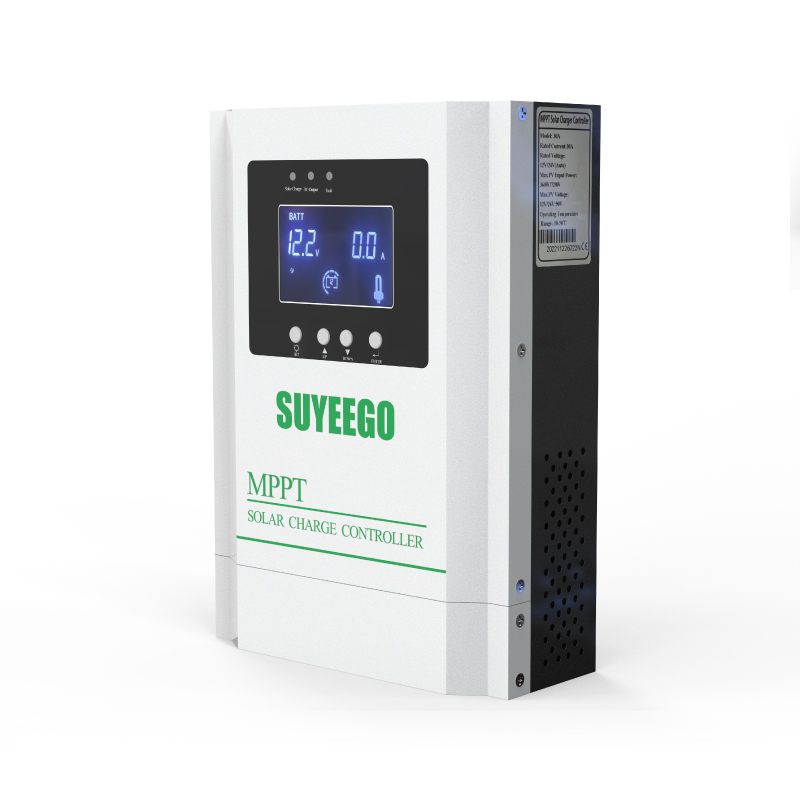
What does the amp rating on an RV MPPT solar charge controller actually mean?
5 min read
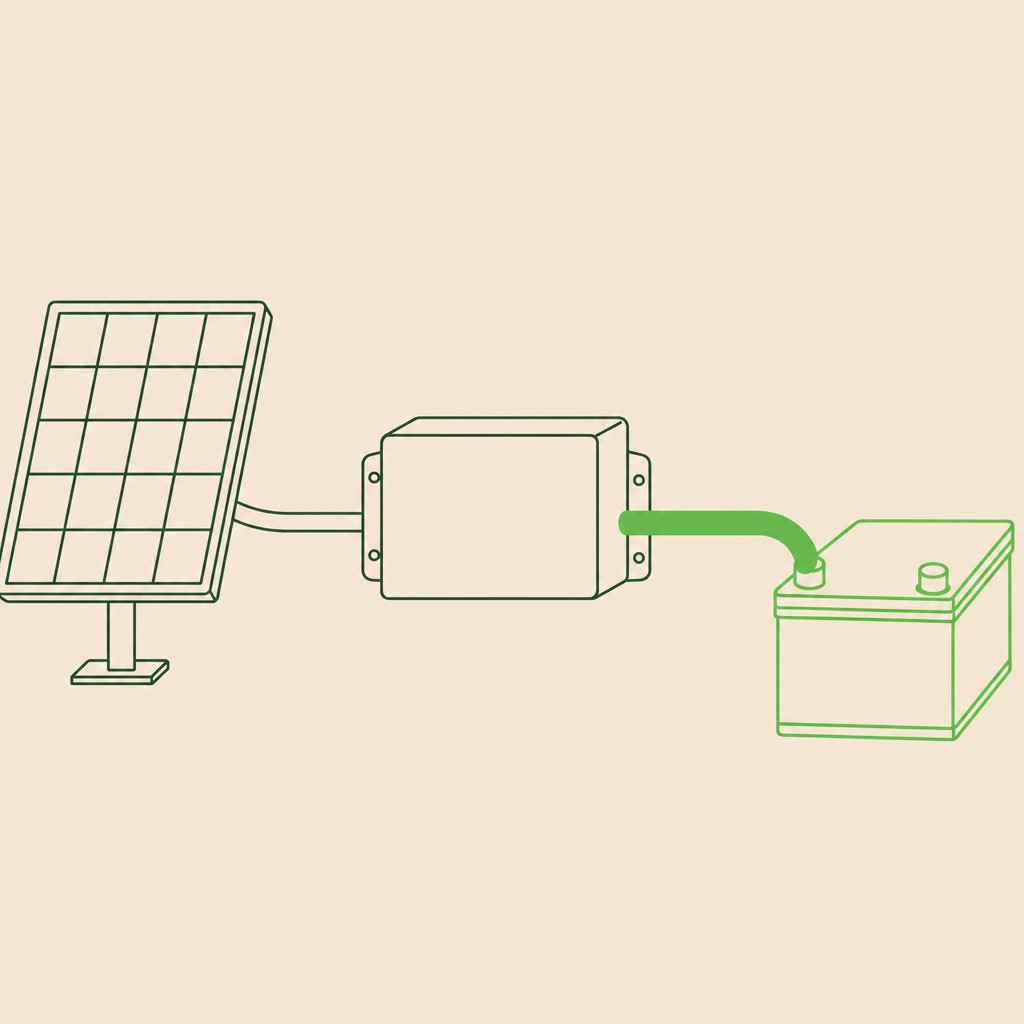
It is the maximum charging current the controller will deliver to the battery, not the current arriving from the solar panels. That distinction matters because the panel side and the battery side of the controller are not the same circuit: the panels feed the controller at whatever voltage the array produces, and the controller delivers a controlled current at the bank voltage. So a 100A controller is not '100A of solar'. It is 100A out to the bank, and how much panel power that represents depends on the bank voltage.
Two circuits, two current ratings
A solar charge controller sits between an array that produces whatever the sun allows and a battery that must be charged to a specific profile. The panels do not push a fixed current into the battery; the controller decides what the battery receives. The amp figure on the label describes the second of those, and only the second.
This is why the panel side of our range is described by a voltage ceiling and a wattage ceiling, while the battery side is described by an amp rating. The two are related by the bank voltage, not equal to each other.
Why the same amps cover more watts on a higher-voltage bank
Power is voltage multiplied by current. If the controller can deliver a fixed current to the battery, then raising the bank voltage raises the amount of power that same current represents. Our 12V and 48V figures follow that relationship directly:
| Model | Max panel power, 12V bank | Max panel power, 48V bank |
|---|---|---|
| 20A | 240W | 960W |
| 30A | 360W | 1440W |
| 40A | 480W | 1920W |
| 60A | 720W | 2880W |
| 80A | 960W | 3840W |
| 100A | 1200W | 4800W |
The 48V column is four times the 12V column at every model, which is what you would expect when the current stays the same and the voltage multiplies by four. This is also why a given array needs a smaller controller on a 48V bank than it does on a 12V bank.
Our published ceilings for 24V and 96V banks, and the full per-model table, are on the product page. Read them per bank voltage rather than assuming one figure covers the whole range.
Choosing by amps alone is a mistake
Two mistakes follow from reading the amp rating as a single number.
- Buying 100A for a 12V bank and expecting to hang 9600W of panels on it. At 12V the published ceiling for that model is 1200W. The battery-side current is the limit, and at 12V a large array simply cannot be absorbed.
- Buying 20A because the array is small, then discovering the array is wired for a 48V bank. At 48V that same model's published ceiling is 960W, so the array may be the thing that is over the limit rather than the controller.
The practical sequence is: settle the bank voltage first, work out the array's total wattage second, and only then read off the model whose published ceiling for that bank voltage sits above the array.
What the amp rating does not tell you
The amp rating says nothing about the array voltage the controller will accept. Those are separate published figures, and on our range they change with the bank voltage too. A controller that is comfortable with a short string at one bank voltage may need a different model at another. The panel-side limits are covered in the guide on choosing between 12V and 24V panels.
It also says nothing about how much of the array's output you will actually get. Tracking efficiency and conversion efficiency are separate published figures, and the rest is weather and orientation.
Frequently asked questions
- Is a 100A controller the right choice for a big array?
- It depends on the bank voltage, not the array on its own. On a 12V bank the published panel ceiling for the 100A model is 1200W; on a 48V bank it is 4800W. The amp rating is the battery-side charging current, so the array wattage it can absorb scales with the bank voltage.
- Does the amp rating include what the controller sends to the DC load output?
- No. The DC load output has its own separately published current rating. On our range the load output defaults to 10A, with 45A available as a maximum on the 30A model and above. The charge current and the load output current are different circuits with different ratings.
- Can I use a controller rated higher than my array needs?
- Oversizing the controller is normal and does not damage anything; the controller only delivers what the array supplies. What you do need to check is the other direction — that the array's wattage and open-circuit voltage stay inside the published ceilings for your bank voltage.