How many solar panels fit on an RV roof?
7 min read
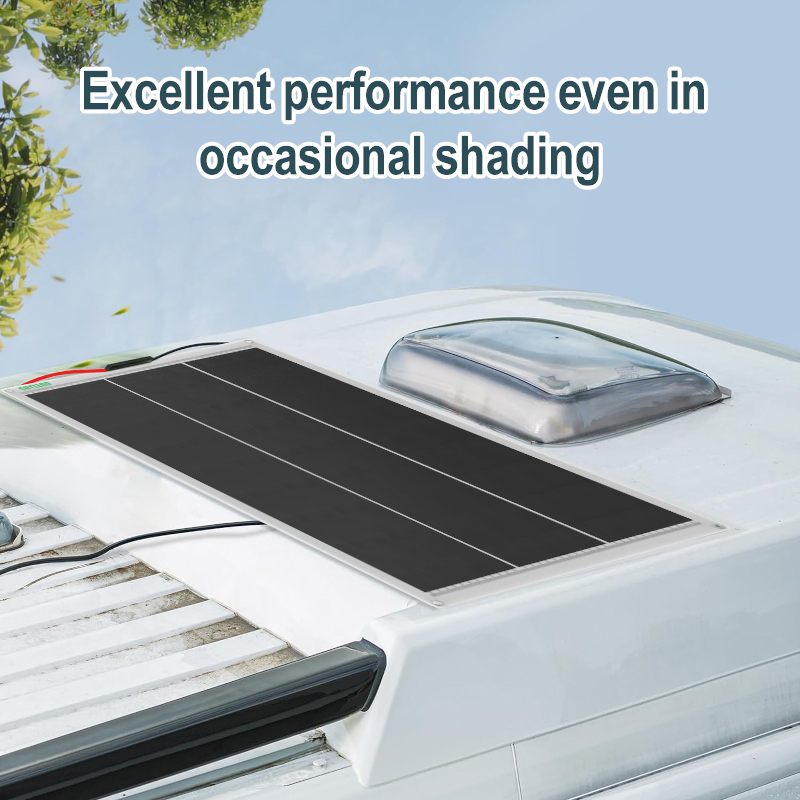
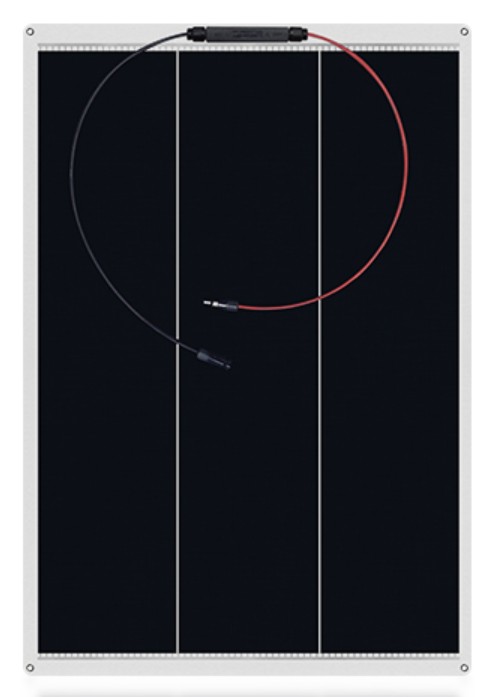
Work it out from the physical size of the panels and the usable dimensions of the roof, not from a rule of thumb. SUYEEGO's flexible panels run from 50W to 230W and grow with their output: a 100W panel measures 1120 × 450 mm and covers about 0.50 m², while a 200W panel measures 1120 × 875 mm and covers about 0.98 m². That is roughly 200W per square metre for the larger models. What limits an array on a van roof is rarely the total area — it is the width left over once vents, skylights, aerials and roof racks have taken their share, which is why several narrow panels often beat a few wide ones.
Start from the size of each model
| Model | Dimensions (mm) | Area (m²) | Roughly W per m² |
|---|---|---|---|
| 50W | 1120 × 450 × 4 | 0.50 | 100 |
| 100W | 1120 × 450 × 4 | 0.50 | 199 |
| 130W | 1250 × 450 × 4 | 0.56 | 231 |
| 150W | 1120 × 670 × 4 | 0.75 | 200 |
| 170W | 1120 × 670 × 4 | 0.75 | 227 |
| 200W | 1120 × 875 × 4 | 0.98 | 204 |
| 230W | 1250 × 875 × 4 | 1.09 | 211 |
The areas are calculated from the dimensions, and the last column is the area divided into the model's wattage. The larger models cluster around 200W per square metre, which is a useful figure to carry in your head: it turns a roof measurement into a rough wattage before you have chosen anything.
Measure the roof, not the vehicle
- Measure the flat, usable surface between the roof's edges, and treat anything standing on it as lost space: a vent, a skylight, an aerial, a roof rack leg or a hatch each removes a rectangle.
- Note where the roof curves away. The panels are 4 mm thick and will follow a gentle curve, but a curved surface gives up some of its nominal area to the curve itself.
- Leave room for the cables to reach a gland or an existing entry point, and for the edges of the panels to sit clear of anything they could chafe against.
- Remember the roof has to stay a roof. Nothing here is walk-on, so a route across it for maintenance is worth keeping clear.
Width decides more than length
Take a usable roof of 2.8 m by 1.6 m as a worked example. Laid with its long edge across the vehicle, a 200W panel uses 875 mm of the width and 1120 mm of the length, so two fit along the roof and the remaining 725 mm of width is too narrow for a second column: 400W in total. Now take 100W panels instead. Three of them fit across the 1600 mm width with room to spare, and two rows fit along the 2800 mm length, which is 600W from the same roof. The narrower panels win because they waste less of the width.
That is an example rather than a template — a real roof has a vent in the middle of it, and the panels have to work around whatever is already there. The method is the part to keep: work out the footprint of the models you are considering, then try to tile that footprint into the shape you actually have.
Match the array to the rest of the system
How much array the roof can take is one limit; how much the system needs is another, and they are not always the same number. Work out the daily energy figure first, because a roof full of panels feeding a battery that cannot absorb the charge is money spent for nothing.
- The charge controller has a maximum input current and a maximum array voltage, and the array has to stay inside both.
- The battery has to be able to accept what the array produces, which is a matter of its capacity and its maximum charge current.
- The wiring between the panels is a decision of its own: series raises the voltage, parallel raises the current, and a roof with panels in different orientations usually suits parallel better.
The flexible panels SUYEEGO builds cover the 50W to 230W range in the sizes in the table above, 4 mm thick and built on 210 × 210 mm cells. Send us the usable roof dimensions and the daily energy figure you are working from, and we will tell you which models fill the space best.
Frequently asked questions
- How many watts of solar will fit on a van roof?
- It depends almost entirely on the usable area. At roughly 200W per square metre for the larger models, a five square metre roof is about 1kW on paper — and less in practice, once vents, skylights and the gaps around them are taken out of it.
- Can I mix different panel sizes on one roof?
- On the roof, yes: what matters is that the panels in a single series string are matched, because the string's current is set by the weakest panel in it. Panels of different sizes or orientations are better wired in parallel, where each contributes independently.
- Do I have to leave gaps between the panels?
- Some separation makes the wiring easier and keeps the edges from chafing against each other. Nothing should overlap, and no cable should be pinched between a panel and the roof.
- Can a panel cover the roof vent?
- No. Vents, skylights, hatches and aerials have to stay clear, both because they need to work and because the panel has to be fitted to a surface it can sit flat on.