Are perovskite solar panels ready for a camper van?
7 min read
Not yet, in the sense that matters to a van build. Perovskite-silicon tandem cells hold the efficiency records, but they are laboratory records, and no panel of this type is being sold for camper roofs by the suppliers that serve this market. What perovskite would eventually change for a van is weight and shape as much as efficiency: the layers are lighter and can be made flexible, which is what a curved roof wants. Until a panel with a warranty exists to buy, a van build is still a silicon build, and the useful preparation is to leave the system able to accept a different panel later.
What the records actually say
The efficiency records belong to tandem cells, where a perovskite layer is stacked on a silicon layer so that each absorbs the part of the spectrum the other handles poorly. As reported in 2025, perovskite-silicon tandem cells had reached a record 34.8%, against 27.3% for the best silicon cells and about 20% for the standard panels on sale today. Perovskites are also lighter, use fewer materials and can be produced at lower temperatures than silicon.
- Record cells are measured in a laboratory, on small areas, under standard test conditions.
- Commercial tandem modules that have started to appear are reported in the mid-twenties per cent, well below the cell records.
- Durability in the field, not efficiency, is the question that decides whether the technology reaches a van roof.
- A manufacturer announced the first commercial shipment of perovskite-silicon tandem panels in 2024, so the technology has crossed from research into production, but into markets where space is scarce and price is not the deciding factor.
Why a record cell is not a roof panel
A panel on a van roof has to survive years of sun, rain, frost, vibration and thermal cycling, and it has to keep its output while doing so. That is what the encapsulation, the frame and the backsheet are for, and it is where a new cell chemistry earns or loses its place. Rigid solar modules are normally sold with performance warranties measured in decades; a technology that is still being demonstrated in thousands of hours of high-temperature operation has not yet shown that span.
That is the honest state of play. The efficiency argument for perovskites is settled in the laboratory; the durability argument is not settled anywhere yet. Manufacturers working on tandem products report encouraging results in accelerated tests, but an accelerated test is an argument, not a warranty.
What it would change on a van roof

- More watts from the same area. Roof space is the hardest limit in a van build, and every point of efficiency returns area that can carry a vent, a skylight or a walkway.
- Less weight per watt. Flexible panels are already the light option, and lighter layers suit roofs that were never designed to carry much.
- Shapes that rigid glass cannot make, which matters on curved or partly obstructed roofs.
- A change to the array arithmetic. Panels of a different voltage change what a series string produces, so the controller has to suit the panels it may eventually see, not only the ones fitted today.
What to do in the meantime
Waiting is a decision with a cost, because the system you do not fit this season collects nothing. The practical answer is to build with silicon now and to make the parts that are expensive to change ready for a different panel later: a controller with PV headroom, cable and fuse with room to spare, roof space left clear, and mounting that can be undone without wrecking the roof.
The figures the range publishes
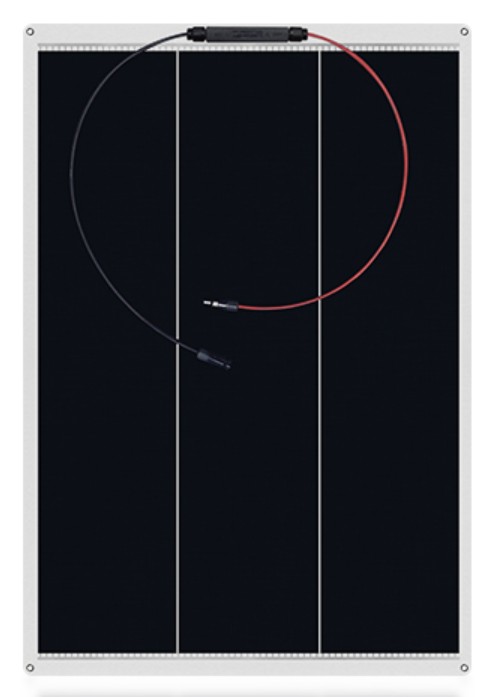
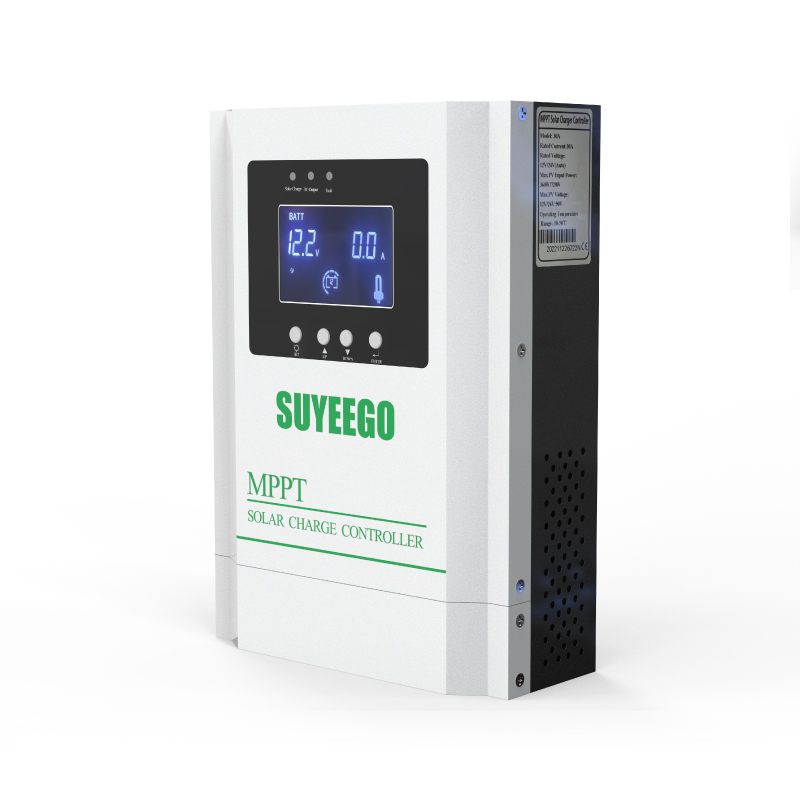
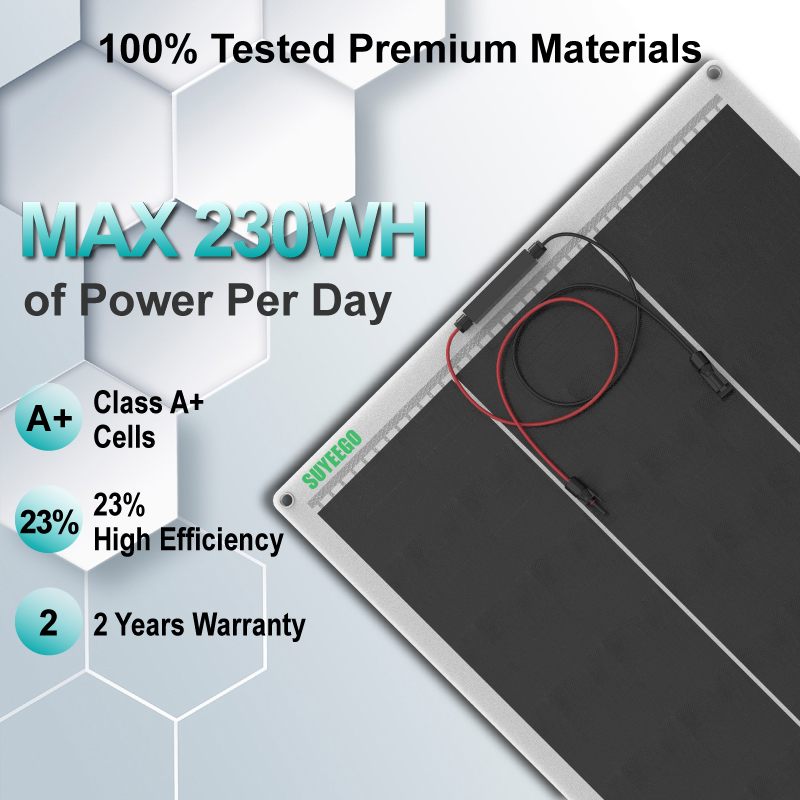
SUYEEGO's flexible panel range (SYGSP-F) runs from 50W to 230W using established silicon cells, with open-circuit voltages between 21.5V and 25.8V and a two-year warranty stated for the range. The MPPT controller range alongside it accepts up to 80V or 130V of PV open-circuit voltage depending on the model, and up to 1200W of panel on a 12V bank, which is the headroom that makes a later change of panels a wiring job rather than a rebuild.
Frequently asked questions
- Will perovskite panels be cheaper?
- That is one of the arguments for them, since the layers use less material and can be made at lower temperatures. Whether that reaches the price of a van panel depends on encapsulation and on manufacturing scale, neither of which is settled, so it is not a reason to plan a build around the technology today.
- Can perovskite panels be flexible?
- Being thin and flexible is one of the reasons the technology is being pursued for vehicles. Flexible perovskite products exist in the laboratory and in development, but there is no flexible perovskite panel with a van-market warranty to buy, so a flexible build today still means silicon.
- Should I wait before buying panels?
- No. A silicon panel fitted now will still be working when the next generation arrives, and the parts that are expensive to change afterwards are the controller, the cable and the roof layout, which are the same whichever panel sits on top of them.
- How efficient are the panels on sale now?
- Standard silicon panels sold for van roofs are typically quoted at around 20% efficiency, and flexible panels are usually quoted lower per unit area than rigid ones of the same class because the cells and the encapsulation differ. That is why the same wattage sometimes needs more roof area in a flexible array.