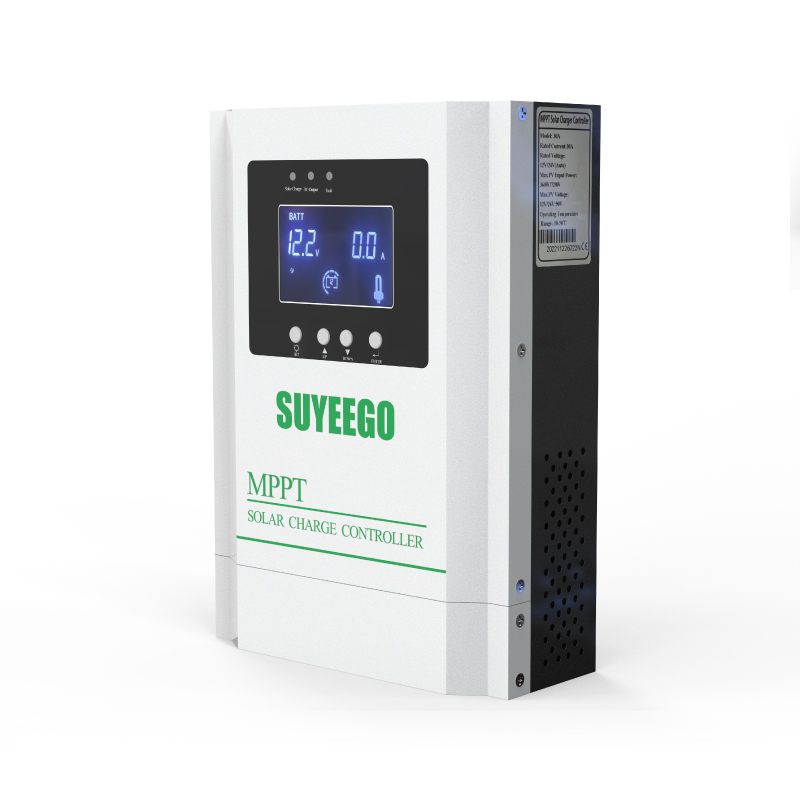
Can you run two RV MPPT solar charge controllers on one battery bank?
5 min read
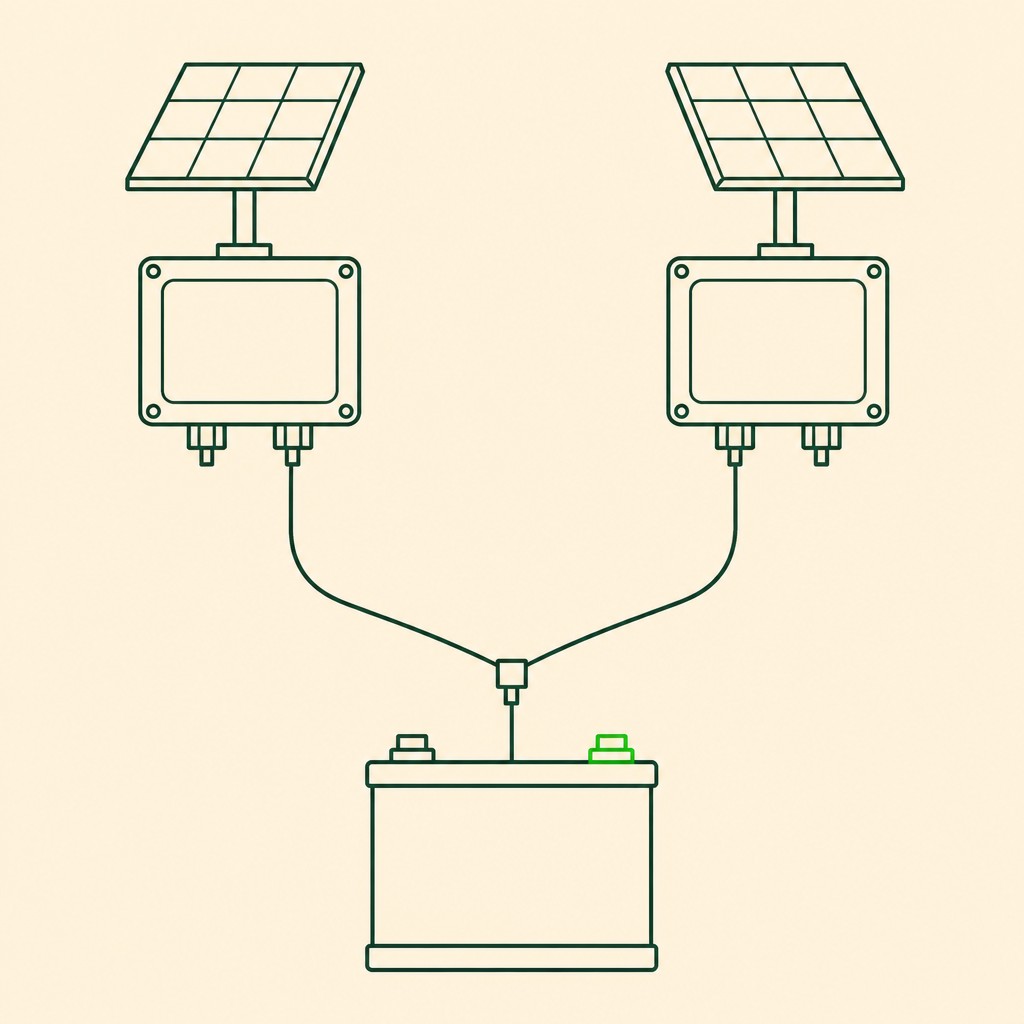
Two controllers can both be connected to one battery bank; each charges it independently using its own profile. What we do not publish is a synchronising or coordinating feature, so we cannot tell you that two of our units will share a charge sequence or divide the current between them by design. If both are set to the same battery profile, both are targeting the same absorption and float voltages, but each is measuring and acting on its own.
Why people end up with two controllers
The usual reasons are practical rather than electrical. A van may have panels on both sides of a roof, or a fixed roof array plus a portable panel that gets moved into the sun. Keeping the two arrays on separate controllers means shading one does not drag down the other, which is the same argument that makes optimisers useful within a single array.
A second reason is expansion. A build may start with one controller and one array, then add a second array later that would push the first controller past its published panel ceiling. A second controller is often simpler than rewiring the original array to a higher bank voltage.
What our published data does and does not cover
We want to be direct about this, because it is the part people assume and then cannot find in the specification.
| Question | What we publish |
|---|---|
| Each controller charges the bank to its own profile | Yes — this is standard behaviour |
| Two units coordinate or synchronise their charge sequence | We do not publish such a feature |
| Two units divide the current between them by design | We do not publish such a feature |
| A shared display or bus between two units | We do not publish one for this range |
If you do run two, set them up consistently
Given that each unit acts on its own measurement, the thing within your control is making sure they agree.
- Set both controllers to the same battery profile. If one is on a lead-acid profile and the other on lithium, they will pull the same bank towards different voltages.
- Both units should sense the battery at the same point. If one measures at the controller terminals and the other at the battery posts, cable voltage drop will make them disagree about the bank's state.
- Fuse each controller separately at the battery. Two charging sources on one bank still need independent protection.
- Check the battery's own charge current limit. Two controllers add up, and the limit that matters is the one on the battery datasheet, not the sum of the controllers' ratings.
When one controller is the better answer
If the two arrays see essentially the same conditions, one controller on a larger model is simpler. Two units on one bank means two devices to configure, two sets of fuses and two things to check when the bank is not reaching its target voltage.
The case for two is when the arrays genuinely differ — different orientations, one portable, or one added long after the build. That is a decision about the array layout more than about the controller.
Frequently asked questions
- Do two MPPT controllers on one bank fight each other?
- They will not damage each other, but they act independently. Each measures the bank voltage and drives towards the voltage its own profile specifies. If both are set to the same profile they are aiming at the same target; if they are set differently, they will pull in different directions.
- Do your controllers support a master-and-slave or synchronised mode?
- We do not publish a synchronising or coordinating feature for this range, so we cannot say that two units will share a charge sequence. Ask us about the specific models you are considering and we will confirm what applies rather than leaving it to inference.
- How do I know the total charge current is safe for my battery?
- The limit that applies is the one published for your battery, not the sum of the controllers' ratings. Add up what you intend to install and compare it with the battery datasheet's maximum charge current before finalising the design.