Can you fit an RV solar system to a pop-top roof?
7 min read

Yes, and a raising roof is one of the better cases for flexible panels: ours are 4mm thick and carry no frame, so they add little height and follow a curved surface. What changes is that every extra kilogram has to be lifted every time the roof goes up, and the cable has to survive that movement thousands of times.
The roof is now something you lift
On a fixed roof a panel is dead weight the vehicle carries. On a pop-top it is dead weight the lifting mechanism carries, and often weight that sits above the hinge line, where it is hardest on the struts. That reframes the question from how much power fits to how much the roof was designed to lift.
We do not publish a panel weight, so the figure to work from is the one on the unit you are considering, added to whatever the roof already carries. If the roof is already loaded with a vent, a rack or an awning, that is where the arithmetic starts, not with the panel.
Why flexible panels suit this roof
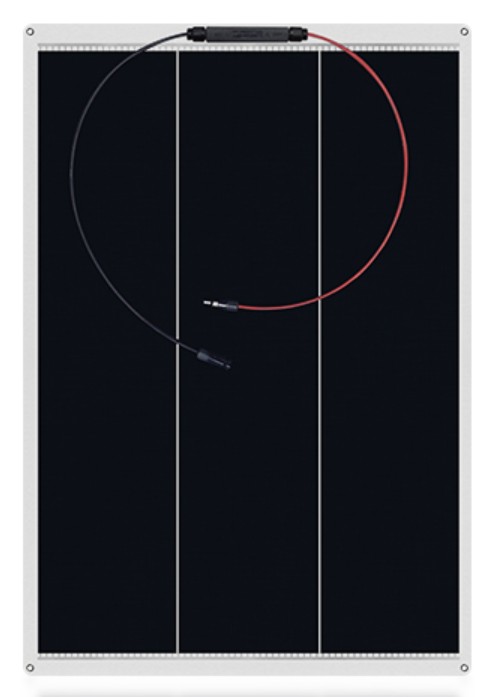
Every panel in our range is 4mm thick and frameless, from the 50W at 1120 × 450 mm up to the 230W at 1250 × 875 mm. There is no frame to stand the panel off the roof and no rigid edge to catch on a cover, which matters when the roof folds down over it.
Flexibility also means the panel can follow a slight crown or curve rather than being stressed across it. That is the difference between a panel that sits on a pop-top for years and one that develops cracks because it was forced flat across a curved surface.
The cable is the part that fails
A raising roof flexes its cable every time it moves. A cable that is merely long enough will eventually fatigue at the point where it bends, usually right at the entry or where it was tied down. The fix is a service loop that spreads the flex over a length rather than concentrating it at one point, and a route that does not let the cable be pinched when the roof closes.
What to check on the roof itself
- Whether the lifting struts are rated for the extra load, and whether the load sits forward of or behind the hinge.
- Whether the surface is rigid enough that the panel is supported across its whole area rather than only at the edges.
- Whether the roof can still close with the panel and its cable in place, with nothing trapped.
- Whether the panel will be shaded by the raised roof, a cover, or the vehicle's own furniture when the roof is up.
What we do not publish
We do not publish panel weight, a maximum roof load, or an approved bonding method. Bonding a panel to a raising roof is a decision about that roof and its covering, and it should be made against the roof maker's guidance rather than inferred from the panel.
Frequently asked questions
- Will a panel stop the roof closing?
- A 4mm frameless panel adds very little height, but it is still height, and the roof may close onto a cover or a bed platform. Check the closed clearance before bonding anything down.
- Can I use a rigid panel on a pop-top?
- It is possible, but a framed panel adds height and a rigid edge, and it does not follow a curved roof. On a raising roof those are the properties that matter most, which is why the flexible format suits this application.
- How do I stop the cable wearing out?
- Give it a service loop so the flex is spread over a length, route it so it is never pinched when the roof closes, and check it through a full cycle before the panel is fixed down.
- Does the roof shade the panel?
- It can, depending on where the panel sits and how the roof opens. A panel mounted behind a raised section can spend part of the day in its shadow, and persistent shade is the condition that causes the most trouble.